
Following our previous article, "Knuckle Boom Cranes Use the Flexible Design of Multi-Joint Folding Booms to Become 'Wall-Crossing and Obstacle-Clearing' Masters for Tight Spaces and Complex Environments," we have already seen how knuckle boom cranes, with their multi-joint folding booms, deliver hooks to "dead corners" that traditional equipment cannot reach – in narrow streets, construction foundation pits, vessel decks, and other complex environments. However, when lifting requirements shift from "flexible maneuvering" to "long-distance crossing" and "high-height lifting" – deep inside ship holds at ports, high-elevation workfaces on construction sites, landing points hidden behind layers of stacked goods in yards, material feeding across ditches in the field – the question is no longer "can we get through," but rather "how far can we reach, how high can we lift, and how much can we still lift at that distance."
The straight boom crane (also known as a straight-boom truck crane or telescopic boom crane) is the specialized equipment born precisely for this "long distance, great height" demand. With its multi-section telescopic boom design, it achieves longer working radius and greater lifting height than knuckle boom cranes for the same equipment weight, making it an indispensable "long-arm expert" in open scenarios such as ports, docks, construction sites, and storage yards. However, many straight boom cranes on the market suffer from issues such as "sticky telescoping, sharp decline in lifting capacity at long distances, and insufficient overall stability," leaving users in critical moments with "just a bit short of reaching, just a bit short of lifting." Wuxi ChuncoTech's answer is: A true "long-arm expert" is not "impressive length numbers on paper," but rather "at every radius, the lifting capacity attenuation is smooth and controlled, giving the operator confidence."
The Distance Philosophy of a Single Extended Boom
A straight boom crane is most notably characterized by a boom consisting of multiple nested box-type sections, achieving continuous changes in boom length through telescopic cylinders or cylinder plus rope-and-pulley mechanisms. Unlike the "folding" of knuckle boom cranes, the "telescoping" of straight boom cranes gives them longer horizontal working radius (up to 20-30 meters) and greater vertical lifting height (exceeding 30 meters) in the extended state, while maintaining a compact transport size in the retracted state for easy relocation.

The core value of a straight boom crane lies in this: It is not designed for "maneuvering in tight spaces," but rather for "long-distance crossing and high-height lifting." The operator can deliver the hook to distances a truck cannot reach, heights a forklift cannot achieve, and behind obstacles other equipment cannot cross. An excellent straight boom crane should enable operators to telescope smoothly, position precisely, and lift stably when facing any long-distance, high-height lifting requirement. In the design and manufacturing of straight boom cranes, Wuxi ChuncoTech takes boom cross-section optimization, telescoping mechanism reliability, and overall stability calculation as its three core areas of focus.
Solving the Three "Distance Dilemmas"
In the use of straight boom cranes, operators worry most about three things: severe attenuation of lifting capacity when the boom is fully extended – "I can reach it, but I can't lift it"; sticking or asynchronization during telescoping, seriously affecting operational efficiency; and insufficient overall stability of the machine when working at long radius under heavy load, making people "nervous."
1.High-Strength Boom and Variable-Cross-Section Optimization Technology: The conflict between boom self-weight and lifting capacity is an eternal challenge in straight boom crane design. We use high-strength structural steel (BS700, BS960 grades) combined with variable-cross-section trapezoidal or hexagonal boom designs to significantly increase the bending section modulus while reducing boom self-weight. Finite element analysis precisely calculates the stress distribution of each boom section, ensuring that in the fully extended state, the deflection at the boom tip is controlled to within millimeters, and the lifting capacity attenuation curve is smooth and controllable. What users get is not "good-looking numbers" for boom length, but lifting performance that is "solid for every meter."
2.Telescoping Mechanism and Synchronization Control Technology: The smoothness of multi-section boom telescoping directly determines the user experience. We use a cylinder plus rope-and-pulley composite telescoping mechanism, combined with precise control of balance valves and sequence valves, ensuring that each boom section extends or retracts in the predetermined sequence – smooth, jam-free, and synchronized. Key telescoping components feature wear-resistant copper bushings and long-life lubrication design, remaining as smooth as ever even in harsh environments such as dust and muddy water.
3.Overall Stability and Outrigger Technology: When working at long radius, overturning stability is the safety bottom line. We equip our cranes with wide-span H-type outriggers or swing outriggers, with outrigger spans optimized through overturning moment calculations to ensure that under maximum radius and rated load conditions, the stability coefficient meets and exceeds international standards. The outrigger hydraulic system is equipped with hydraulic locks and double counterbalance valves – even if a hydraulic hose bursts unexpectedly, the outriggers remain locked in position, eliminating the risk of "soft legs."
From Ports to Construction Sites: A Vast World Within Reach of a Long Arm
Wuxi ChuncoTech's straight boom cranes are widely used in cargo lifting deep inside ship holds at ports, long-distance material feeding of rebar and formwork on construction sites, material crossing transport in bridge construction, high-bay rack access in warehousing and logistics, field power line construction, and large-tree planting and transplanting in municipal landscaping. Compared to knuckle boom cranes, the straight boom crane has longer working radius, greater lifting height, and superior long-distance lifting capacity as its core advantages – the two complement each other: knuckle boom cranes handle "wall-crossing and obstacle-clearing," while straight boom cranes handle "long-range placing and high lifting." When knuckle boom cranes handle "tight and flexible" and straight boom cranes handle "open and long-distance," Wuxi ChuncoTech builds for its customers a complete lifting capability map ranging from near to far, from low to high, from complex environments to open spaces.
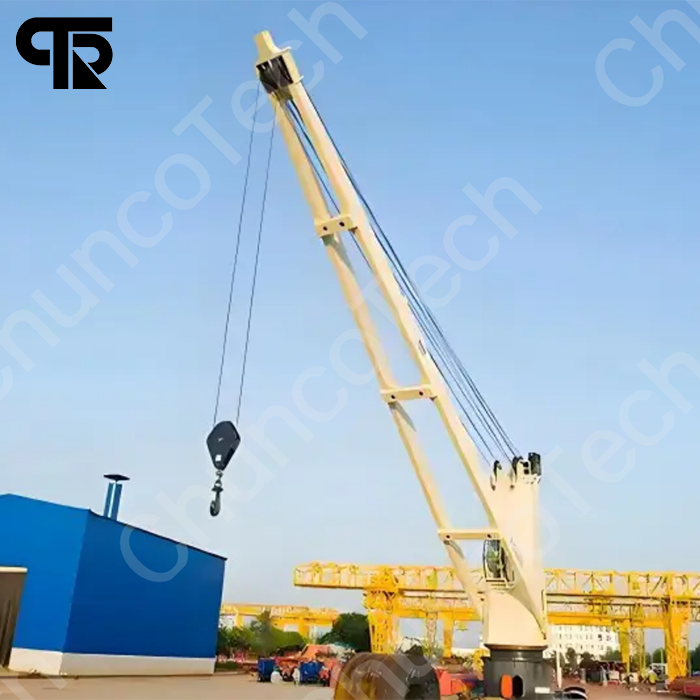
Choosing Wuxi ChuncoTech means you receive not just a straight boom crane, but a mature solution validated by thousands of units of mass production. All our products are mature models already in volume production with highly reliable telescoping mechanisms and hydraulic systems. Whether you need a marine straight boom crane for a port dock or a large-tonnage straight boom truck crane for a construction site, please visit our website at https://www.chuncotech.com/ to obtain a professional solution for long-distance and high-height lifting.