
Following our previous article, "Mooring Pillars Use Ultra-High Strength and Impact Resistance to Become the 'Steel Arm' for Safe Ship Berthing at Docks," we have already seen how mooring pillars, as rigid anchor points on quaysides and vessel decks, firmly withstand hundreds of tons of pulsed pulling force transmitted through mooring ropes. However, when we shift our perspective from "mooring and securing" to "mobile lifting" – equipment installation on city streets, work inside narrow foundation pits on construction sites, tight clearances between machinery in factories, supply lifts on vessel decks, and behind obstacles at rescue sites – traditional lifting equipment often finds itself "helpless." Straight boom cranes have booms that are too long to slew in tight spaces, forklifts lack sufficient height, and standard truck-mounted cranes lack flexibility. These "can't reach, can't fit" awkward scenarios consume the time and patience of engineers and operators every single day.
The knuckle boom crane (also known as an articulating crane, folding boom crane, or articulated crane) is precisely designed to solve these "dead corner" problems. With its multi-joint folding boom design, it moves through complex environments as flexibly as a "robotic arm," calmly completing lifts where others "cannot even turn around." However, many knuckle boom cranes on the market suffer from problems such as "sticky telescoping, play in slewing, weak heavy-load boom folding, and hydraulic system leakage," making equipment that should go "wherever you point" become "feeble and unresponsive." Wuxi ChuncoTech's answer is: A true "wall-crossing and obstacle-clearing" master is not "having a long enough boom," but rather "being able to complete every movement smoothly and stably with coordinated multi-joint action where others can't even turn around."
More Joints, Fewer Dead Corners
A knuckle boom crane is most notably characterized by a boom consisting of multiple foldable box-type sections, with hydraulic cylinders achieving unfolding, folding, and telescoping between sections. Compared to traditional straight boom cranes, the greatest advantage of a knuckle boom crane is: the boom can "fold back" to work like a human arm, delivering the hook to designated positions in "non-typical" work areas such as low-clearance spaces, narrow passages, and behind obstacles. Based on the number of boom sections, it can be classified into two-section, three-section, four-section, or even five-section booms. Based on the slewing configuration, it can be classified into turret-mounted type (installed on a truck chassis) and pedestal-mounted type (installed on a fixed base).
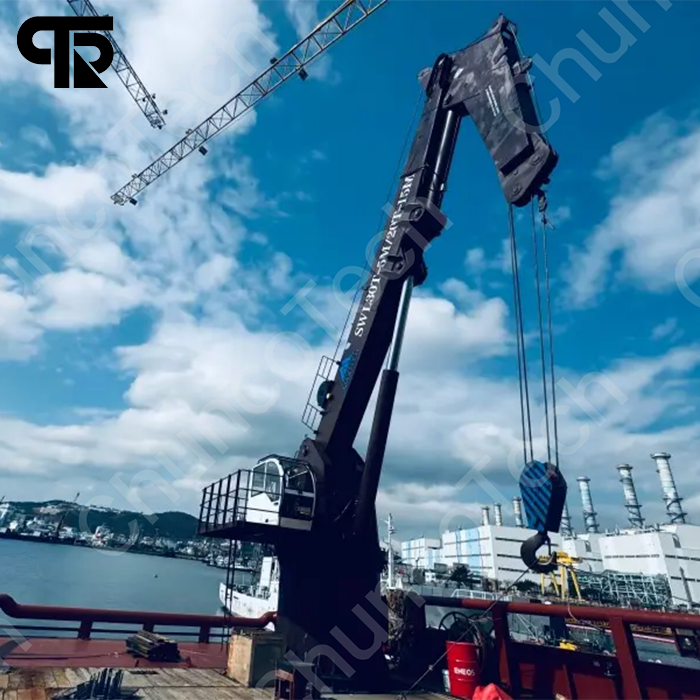
The core value of a knuckle boom crane lies in this: It is not designed for "open spaces," but rather for "complex environments, tight spaces, and behind obstacles." Its lifting targets are often not neatly stacked containers or standard workpieces, but rather scattered, temporary, awkwardly positioned loads – from rebar and precast slabs on construction sites to machinery in factories, from supply re-supply on vessel decks to obstacle removal in rescue operations. An excellent knuckle boom crane should enable operators to calmly unfold, coordinate multiple joints, precisely reach, and stably lift when facing any "awkward" position. In the design and manufacturing of knuckle boom cranes, Wuxi ChuncoTech takes multi-joint coordinated control, proportional hydraulic systems, heavy-load slewing stability, and cylinder self-locking with anti-droop protection as its four core technical areas.
Solving the Three "Motion Obstacles"
In the use of knuckle boom cranes, operators are most frustrated by three things: jerky and discontinuous boom extension and folding, making multi-joint coordination difficult; "play wobble" in the slewing mechanism under heavy loads, causing inaccurate load positioning; and oil leaks and "boom droop" after prolonged use, with the boom descending on its own under heavy load.
1.Proportional Valve Control and Multi-Boom Coordination Technology: A knuckle boom crane has two to five or even more hydraulic joints. We employ electro-hydraulic proportional control technology paired with a load-sensing hydraulic system to achieve synchronized linkage or independent fine motion of each boom section. Whether a single joint is moving alone or multiple joints are performing compound movements, we achieve stepless speed control, smooth transitions, and jerk-free operation. With just a gentle push of the joystick, the equipment obediently completes complex motion sequences. For higher-end configurations, an optional wireless remote control system is available, allowing the operator to stand away from the equipment to observe the lifting point, further improving safety and visibility.
2.Heavy-Load Slewing and Backlash Elimination Technology: Axial play and radial play in the slewing mechanism are the root causes of "play wobble." We use pre-loaded slewing rings and double-row roller structures to eliminate slewing play at the mechanical level. Additionally, slewing cushion valves automatically adjust hydraulic flow during start and stop phases, avoiding "nodding" and "fishtailing" caused by inertia, ensuring that under heavy-load slewing, the load remains level and the pointing remains precise. The slewing drive can be powered by a hydraulic motor or a variable frequency electric motor – the latter offering lower energy consumption and more precise control in applications with frequent start-stop cycles.
3.Cylinder Self-Locking and Anti-Droop Technology: Internal leakage in hydraulic cylinders is the main cause of "boom droop" in knuckle boom cranes – and also the greatest safety hazard. We employ hydraulic lock plus counterbalance valve dual protection – even if a hydraulic hose bursts unexpectedly, the boom remains locked at its current angle and will not suddenly fall. At the same time, key cylinders are equipped with built-in cushion structures that absorb impact energy when the boom extends to its limit position, extending the service life of cylinders and joints. For ultra-large tonnage knuckle boom cranes, optional cylinder displacement sensors are available, monitoring each cylinder's stroke in real time and interfacing with the control system to achieve more precise coordinated control and fault prediction.
From Truck-Mounted to Fixed: The Ubiquitous "Transformer"
Wuxi ChuncoTech's knuckle boom cranes are widely used in truck-mounted transport and lifting, rebar and formwork lifting on construction sites, factory equipment repair and installation, vessel deck supply re-supply, field power line repair, landscaping large-tree transplanting, emergency rescue and obstacle clearance, and vertical and horizontal material handling in warehouses. Compared to straight boom cranes, the knuckle boom crane has multi-joint folding boom, ability to maneuver in tight spaces, truck-mounted mobility, and strong adaptability to complex environments as its core advantages. When straight boom cranes handle "long-distance placing and high lifting" and knuckle boom cranes handle "wall-crossing and obstacle-clearing," Wuxi ChuncoTech builds for its customers a complete lifting capability map ranging from open spaces to tight spaces, from long-distance to complex environments, from fixed installation to truck-mounted mobility.
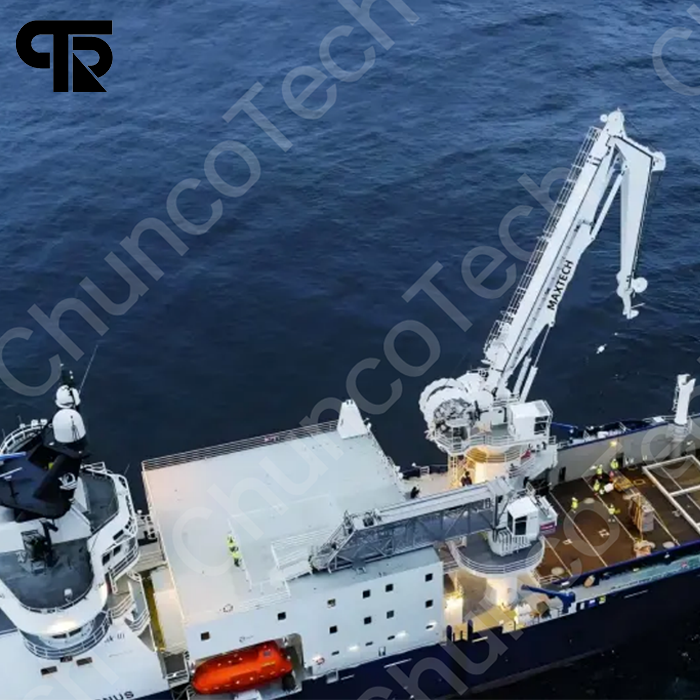
Choosing Wuxi ChuncoTech means you receive not just a knuckle boom crane, but a mature solution validated by thousands of units of mass production. All our products are mature models already in volume production with highly reliable hydraulic systems and multi-joint mechanisms. Whether you need a truck-mounted knuckle boom crane for your fleet or a fixed knuckle boom crane for your factory workshop, please visit our website at https://www.chuncotech.com/ to obtain a professional solution for flexible lifting in complex environments and tight spaces.