
Following our previous article, "Mooring Ropes Use Ultra-High Strength and Weather Resistance to Become the 'Lifeline' for Safe Ship Berthing at Ports," we have already seen how mooring ropes, with their excellent aging resistance and fatigue resistance, bear all dynamic loads from wind and wave impacts at port terminals and offshore platforms. However, one end of the mooring rope is connected to the vessel – what is the other end attached to? If the mooring point itself is not strong, even the best mooring rope is useless. Bollards pulled out of the dock, mooring ears cracked on floating docks, fairleads deformed on platforms – the root cause of these failures is often not a broken rope, but a mooring pillar that was not strong enough.
The mooring pillar (also known as a bollard, mooring bollard, or dolphin) is precisely the last and most critical link in this "mooring safety chain." It is a load-bearing structural component fixed to a dock, floating dock, vessel deck, or offshore platform – the anchor point through which mooring ropes transmit their loads. However, many mooring pillars on the market suffer from shortcomings such as "insufficient design strength, stress concentration at welds, poor impact fatigue resistance, and short corrosion-protected service life," leaving port managers and ship owners "uncertain at heart." Wuxi ChuncoTech's answer is: A true "steel arm" is not "strong enough under static pull," but rather "under extreme conditions of millions of impacts, severe corrosion, and unexpected overloads, remains firmly rooted without the slightest movement."
The "Last Link" in Mooring Safety
A mooring pillar is a load-bearing casting or fabricated component installed on quaysides, floating dock wing walls, vessel decks, or the edges of offshore platforms. Based on structural type, it is mainly classified into double-bitt bollards (most common), single-bitt bollards, cross bollards, inclined bollards, and roller bollards (with guiding rollers). Based on installation method, it is classified into base-mounted type (secured with anchor bolts into concrete or steel structures) and through-deck type (penetrating the deck or platform, with a backing plate underneath). Based on material, it is mainly classified into cast steel mooring pillars, fabricated steel plate mooring pillars, and ductile iron mooring pillars.
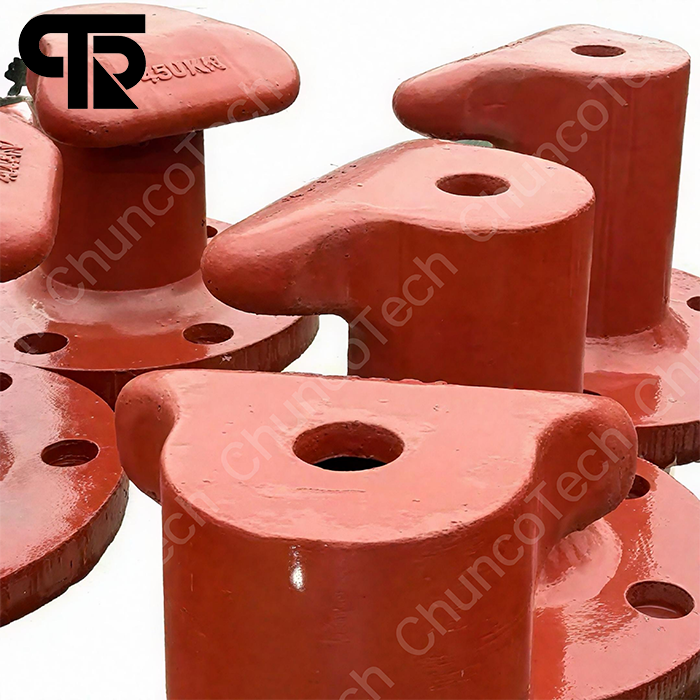
The core value of a mooring pillar lies in this: It is not a "flexible connector," but rather a "rigid anchor point" – under repeated application of hundreds of tons of pulling force transmitted through the mooring rope, it must not experience any loosening, deformation, or fatigue cracking. For a 300,000-ton Very Large Crude Carrier (VLCC) in severe weather, the pulling force transmitted from a single mooring rope to the mooring pillar can reach 50 to 100 tons, applied in a pulse-like repeating pattern with tides and waves. The failure of a single mooring pillar can lead to the entire vessel breaking free, drifting, or even colliding. In the design, manufacturing, and inspection of mooring pillars, Wuxi ChuncoTech takes static load strength, impact fatigue resistance, corrosion-protected service life, weld or casting quality, and anchor bolt reliability as its five core areas of focus.
Solving the Three "Mooring Pillar Anxieties"
In port mooring operations, port managers and crew members worry most about three things: the mooring pillar being pulled out by the roots, with anchor bolts breaking or the concrete foundation being torn apart; root cracking of the mooring pillar, with fatigue cracks developing in welds or castings after long-term impact; and corrosion thinning of the mooring pillar, with strength decreasing year by year without anyone knowing.
1.Ultra-High Strength Design and Static Load Safety Margin: The design pulling capacity of a mooring pillar must have an adequate safety margin. We follow specifications from the International Navigation Association (PIANC), the International Organization for Standardization (ISO), and the Ministry of Transport of China, with the design breaking load of the mooring pillar not less than 1.5 to 2 times the minimum breaking load of the mooring rope. For ultra-large tonnage terminals, we recommend cast steel mooring pillars, which have no welds, uniform material properties, and optimized stress distribution through integral casting. Each mooring pillar undergoes a static load test at 1.5 times the design load before leaving the factory, ensuring that under extreme conditions it "cannot be pulled apart or pulled out."
2.Impact Fatigue Resistance and Root Reinforcement Design: Pulse-type impacts from vessels in wind and waves are the main cause of fatigue damage to mooring pillars. We employ large-radius fillet transitions and local thickening at the root of the mooring pillar – the cross-section with the highest stress – to eliminate stress concentration. For fabricated (welded) mooring pillars, critical welds are full-penetration welded and undergo 100% magnetic particle inspection or ultrasonic testing after welding. For cast steel mooring pillars, critical areas undergo 100% radiographic inspection. Through finite element analysis to optimize geometry, our mooring pillars remain crack-free and loose-free for over 2 million fatigue cycles.
3.Long-Life Corrosion Protection and Embedded Part Reliability: Mooring pillars on quaysides operate for long periods in the harsh corrosive environment of salt spray, tidal splash zones, and alternating wet-dry cycles. We employ a dual-coat system: an epoxy zinc-rich primer base coat and a high-build epoxy or polyurethane topcoat, with total dry film thickness not less than 200 microns. For critical projects, optional stainless steel mooring pillars or thermal spray aluminum (TSA) plus sealer coat solutions are available, achieving over 30 years of maintenance-free service. Anchor bolts are Grade 10.9 high-strength galvanized bolts, with embedment depth and anchorage length calculated for pull-out and shear resistance, eliminating "root loosening" and "foundation pull-out."
From Docks to Vessels: Full-Scene Coverage of Mooring Pillars
Wuxi ChuncoTech's mooring pillar products are widely used at large container terminals, bulk cargo terminals, oil tanker and liquefied natural gas terminals, cruise ship terminals, floating docks, vessel decks, offshore drilling platforms, and lock and ship lift mooring systems. Compared to mooring ropes which serve as "flexible connectors," the mooring pillar has rigid anchor point, dual design for static load and fatigue, long corrosion-protected service life, and anchor bolt reliability as its core characteristics. Together, they form the two ends of the mooring safety chain – the mooring rope at one end and the mooring pillar at the other. When the mooring rope handles "holding the load" and the mooring pillar handles "anchoring firmly," Wuxi ChuncoTech builds for its customers a complete mooring safety system ranging from flexible to rigid, from dynamic to static, from rope to structure.
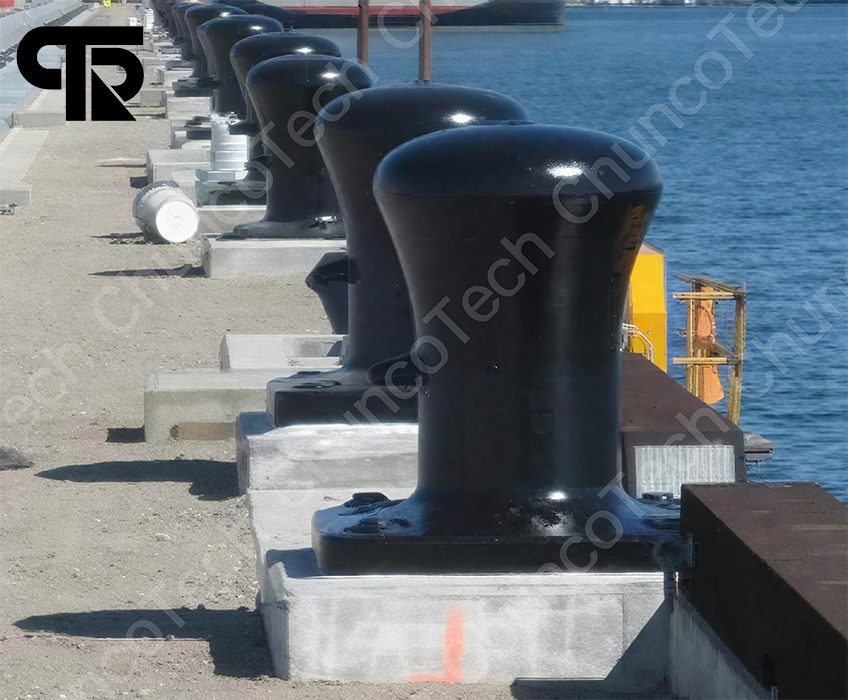
Choosing Wuxi ChuncoTech means you receive not just a mooring pillar, but a mature mooring anchor point solution validated by tens of large port and terminal projects. All our products are reliable products with mature designs, standardized manufacturing processes, and 100% load-tested quality. Whether you need large-tonnage cast steel mooring pillars for a new container terminal or corrosion-enhanced mooring pillars for an LNG terminal, please visit our website at https://www.chuncotech.com/ to obtain a professional solution for safe vessel mooring anchor points at ports.