
Following our previous article, "Mobile Belt Conveyors Use Flexible Transfer and Efficient Conveying to Become the 'Transfer Artery' Between Bulk Cargo Terminals and Yards," we have already seen how mobile belt conveyors, with flexible transfer and continuous conveying, open up the "last mile" of bulk cargo logistics between terminals and yards. However, when cargo handling is complete and vessels are about to depart or have just berthed, a safety-critical question becomes paramount: After a giant vessel of several hundred thousand tons berths at a dock, what holds it firmly "tied" to the dock? When a storm strikes, what prevents the vessel from drifting or colliding? With tidal changes and wave impacts, can the ropes withstand the forces?
The mooring rope (also known as a mooring line or berthing rope) is the core answer to this "ship mooring safety" question. It is the only flexible link connecting the vessel to the dock, the vessel to the floating dock, or the vessel to another vessel – bearing all dynamic loads from wind, waves, and tidal forces. However, many mooring ropes on the market suffer from shortcomings such as "rapid strength loss, poor UV and salt spray resistance, uncontrolled elasticity, and weak splices," leaving port managers and crew members constantly anxious. Wuxi ChuncoTech's answer is: A true "lifeline" is not "how high the breaking strength is when new," but rather "how reliably it maintains its residual strength under harsh conditions of sun exposure, rain, salt spray, and repeated tension."
The "Lifeline" of Ship Mooring
A mooring rope is a flexible connector used to secure a vessel to a dock, floating dock, offshore platform, or another vessel. Based on material, it is mainly classified into synthetic fiber ropes (such as ultra-high molecular weight polyethylene, nylon, polypropylene, and polyester), natural fiber ropes (such as manila hemp, now less commonly used), and wire rope mooring lines (for ultra-large tonnage or special applications). In modern port and offshore engineering, high-performance synthetic fiber ropes have become the mainstream choice due to their comprehensive advantages of high strength, low weight, corrosion resistance, UV resistance, and moderate elasticity.

The core value of a mooring rope lies in this: It does not "lift heavy objects," but rather "withstands wind and waves" – under dynamic, cyclical, unpredictable external forces, it holds the vessel firmly in its intended position. A 300,000-ton Very Large Crude Carrier (VLCC) can impose a total tension of several hundred tons on its mooring ropes during severe weather. The failure of a single mooring rope can lead to the entire vessel drifting, colliding with the dock, or even grounding. In the selection, inspection, and supporting services for mooring ropes, Wuxi ChuncoTech takes breaking strength, fatigue resistance, weather resistance, splice reliability, and elasticity with shock absorption as its five core areas of focus.
Solving the Three "Mooring Anxieties"
In vessel mooring and port operations, port managers and crew members worry most about three things: excessive strength loss of the rope – a new rope that somehow "cannot handle the load"; rope failure at the splice – the end pulling loose, causing the vessel to become uncontrolled; and uncontrolled elasticity – either too stiff to absorb shock loads or too soft, allowing excessive vessel movement.
1.High-Performance Fiber Selection and Anti-Aging Design: Based on operating conditions such as vessel tonnage, berthing environment, UV exposure level, and chemical contact risk, we recommend the optimal fiber material for each customer. Ultra-high molecular weight polyethylene ropes offer the highest strength, lightest weight, and excellent abrasion resistance, making them suitable for ultra-large tonnage vessels and deep-water mooring. Nylon ropes offer the best elasticity and highest energy absorption, making them suitable for docks with large tidal ranges and high waves. Polypropylene ropes float on water and are economical, making them suitable for temporary mooring and inland waterway vessels. All synthetic fiber ropes are treated with UV stabilizers and anti-salt spray treatment, extending their service life in outdoor environments by over 50%.
2.End Fitting Reinforcement and Socketing Technology: Over 80% of mooring rope failures occur at the splice or end fitting. We use high-strength socket fittings or double-braided eye splice techniques, achieving a strength retention rate of 90% to 95% at the splice. For ultra-large tonnage mooring ropes, optional stainless steel or galvanized sockets are available, paired with tapered socket and resin capel technology, casting the rope end and socket into a single integral unit – zero slippage, zero loosening. Every splice is subject to 100% break-test sampling before leaving the factory, ensuring that splice strength is "never compromised."
3.Elasticity Matching and Mooring Dynamics Optimization: The elastic modulus of a mooring rope directly determines the vessel's motion amplitude under wind and waves and the peak loads imposed on the rope. Too low elasticity, and shock loads from the vessel are transmitted instantaneously to the rope and bollard, causing "hard-on-hard" damage; too high elasticity, and the vessel moves excessively, potentially striking the dock or adjacent vessels. Based on mooring dynamics analysis, we recommend the optimal elastic modulus rope combination for each customer, and can provide mixed-rope solutions as needed – retaining sufficient energy absorption capacity while controlling vessel motion amplitude within safe limits.
From Docks to Offshore Platforms: Full-Scene Coverage of Mooring Ropes
Wuxi ChuncoTech's mooring rope products and supporting services are widely used at large container terminals, bulk cargo terminals, oil tanker terminals, liquefied natural gas terminals, floating dock mooring, offshore drilling platform station-keeping, ship-to-ship lightering operations, and naval and public service vessel berthing. Compared to wire ropes used as "hoisting lifelines" in lifting equipment, mooring ropes have large diameters, extra-long lengths, priority on weather resistance, and critical splice technology as their core characteristics. When wire ropes handle "lifting the load" and mooring ropes handle "holding the vessel," Wuxi ChuncoTech builds for its customers a complete safety connection system ranging from lifting operations to vessel mooring, from vertical lifting to horizontal restraint.
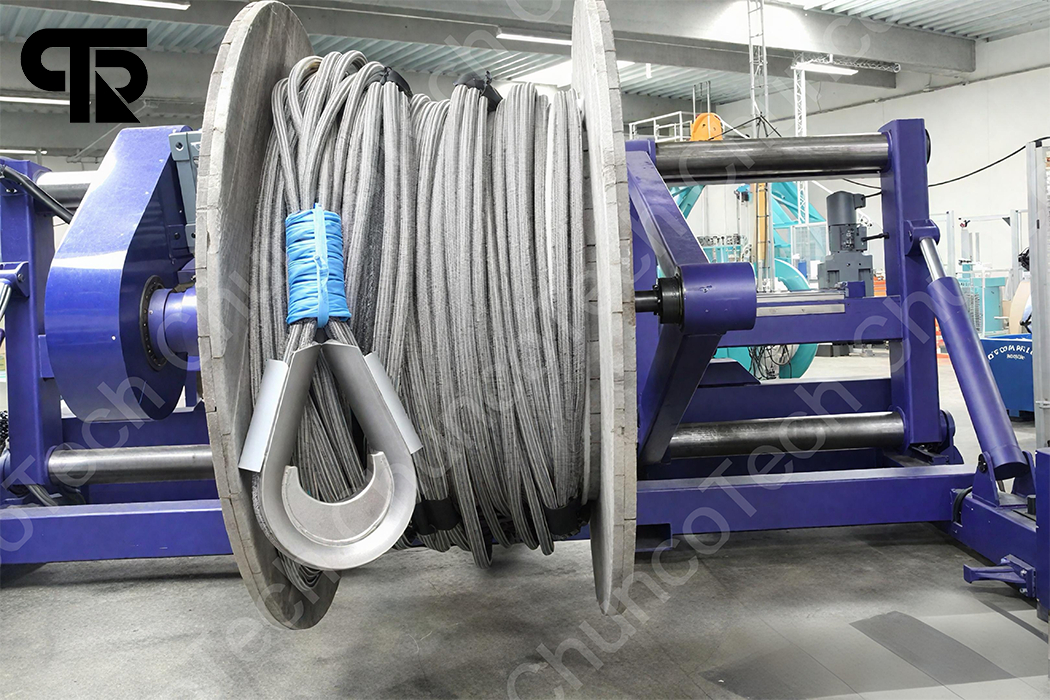
Choosing Wuxi ChuncoTech means you receive not just a mooring rope, but a mature mooring solution validated by tens of large port and shipping projects. All our products are reliable products made from world-class fiber raw materials, mature manufacturing processes, and 100% batch tensile testing. Whether you need ultra-high molecular weight polyethylene mooring ropes for a new container terminal or anti-static specially treated ropes for an LNG terminal, please visit our website at https://www.chuncotech.com/ to obtain a professional solution for safe vessel mooring connection at ports.