
Following our previous article, "Ship Loaders Use Continuous and Efficient Operation to Become the 'Steel Dragon' for Unlocking the Loading Process at Bulk Cargo Terminals," we have already seen how ship loaders at bulk cargo terminals continuously load cargo from rear yards into ship holds at rates of thousands of tons per hour. However, between the ship unloader and the yard, between the yard and the ship loader, and between trains and trucks – those "last mile" short-distance transfer links – there are also efficiency bottlenecks: fixed belt conveyors require large investment and land occupation and cannot flexibly adjust routes; wheel loaders have low transfer efficiency, high costs, and generate significant dust; dump trucks shuttling back and forth between the dock and the yard consume high fuel, produce high emissions, and cause severe road wear.
The mobile belt conveyor (also known as a portable belt conveyor or mobile hopper loader) is the flexible solution designed precisely to solve these "short-distance transfer bottlenecks." With crawler or rubber-tyred travel mechanisms, it can be quickly relocated and freely combined, building "plug-and-play" conveying arteries between bulk cargo terminals, yards, storage areas, and construction sites. However, many mobile belt conveyors on the market suffer from chronic issues such as "severe belt misalignment and spillage, difficult telescoping adjustment, time-consuming relocation, and easily damaged belt splices," turning what should be efficient transfer operations into a "messy and sluggish" struggle. Wuxi ChuncoTech's answer is: A true "transfer artery" is not "just being able to run a belt," but rather "quick to relocate, stable in operation, spill-free, and low in energy consumption."
The Conveying Artery That Walks
A mobile belt conveyor is a continuous conveying device that can move freely within a work site. Its structure consists primarily of a crawler or rubber-tyred travel mechanism, frame, belt conveying system, drive unit, feed hopper, and electrical control system. Unlike fixed belt conveyors, mobile belt conveyors can adjust their position at any time as the work face changes. Multiple units can be connected in series to form temporary conveying lines, or arranged in parallel to achieve multi-point simultaneous feeding or discharging.
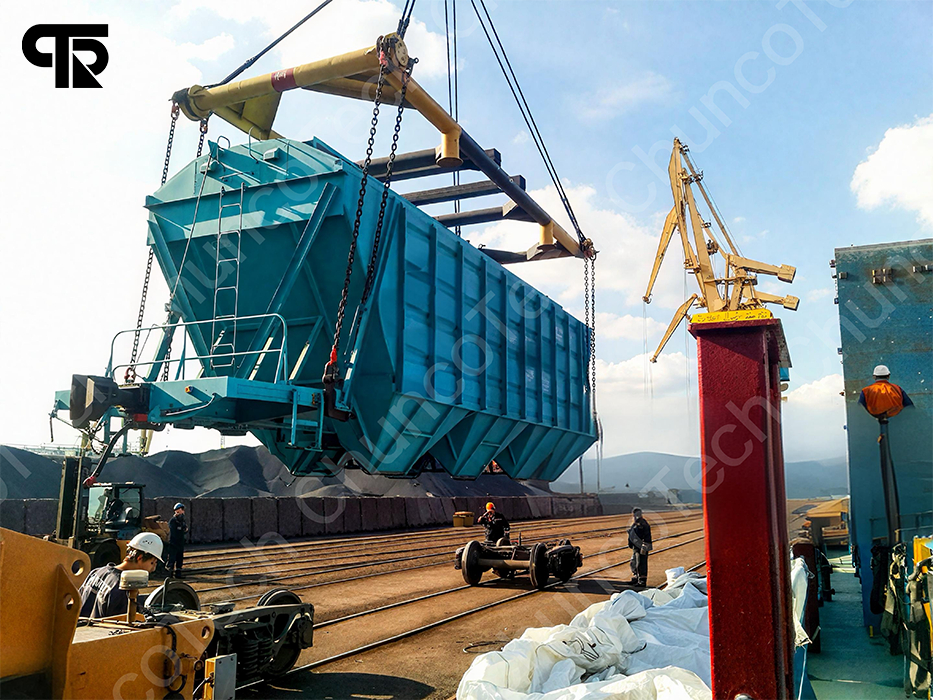
The core value of a mobile belt conveyor lies in this: It is not designed for "permanent fixed routes," but rather for "flexible, fast, low-cost short-distance transfer." A typical mobile belt conveyor can achieve a conveying capacity of 500 to 2,000 tons per hour and a conveying length of 20 to 50 meters, with multiple units connected in series to extend to hundreds of meters as needed. It can receive material directly under a ship unloader's hopper and convey it directly to the yard; or take material from the yard and convey it directly to a ship loader; or build a temporary bridge between trains and trucks. In the design and manufacturing of mobile belt conveyors, Wuxi ChuncoTech takes easy travel and relocation, anti-misalignment and spill prevention, telescoping and angle adjustment, and rapid connection and disassembly as its four core technical areas.
Solving the Three "Transfer Challenges"
In short-distance transfer operations, site managers are most frustrated by three things: severe belt misalignment and material spillage, not only wasting material but also requiring additional manual cleanup; difficult equipment relocation, with move times stretching to several hours, seriously affecting operational continuity; and difficult multi-unit connection, with material overflow and misalignment at the interfaces between units.
1.Anti-Misalignment and Spill Prevention Technology: Belt misalignment is the most common problem with mobile belt conveyors. We use tapered self-aligning idler sets and automatic alignment devices, combined with belt misalignment sensors for real-time monitoring – once misalignment is detected, automatic correction is triggered immediately. Both sides of the belt are equipped with anti-spillage skirt boards and deflector plates. Impact idler sets and feed chutes at the feed point effectively absorb the impact of falling material and prevent spillage from the sides. Belt splices are made using mechanical fasteners or vulcanized splices, which offer high strength, long service life, and no edge curling.
2.Rapid Relocation and Telescoping Adjustment: The value of a mobile belt conveyor lies in its ability to "move." Crawler-type travel mechanisms can turn in place, making them suitable for soft ground; rubber-tyred travel mechanisms offer faster relocation speeds and are suitable for paved surfaces. The equipment is equipped with a hydraulic lifting system that can quickly adjust the height of the feed and discharge points to suit different equipment interface requirements. A telescoping frame design allows the conveying length to be adjusted steplessly within a certain range without adding or removing intermediate sections – length adjustments can be completed in 5 to 10 minutes.
3.Modular Design and Rapid Connection: When multiple mobile belt conveyors are connected in series, interface alignment and material transition are key challenges. We use standardized interface dimensions and quick-locking mechanisms, allowing two units to be connected in 15 minutes or less. Transition chutes or overlapping deflector plates ensure that material transitions smoothly from one unit to the next without spillage or accumulation. When multiple units operate together, a centralized electrical control system can synchronously adjust the belt speeds of all units to achieve full-line flow matching.
From Terminals to Construction Sites: The "Full-Scene" Coverage of Mobile Belt Conveyors
Wuxi ChuncoTech's mobile belt conveyors are widely used in short-distance transfer between ship unloaders and yards at bulk cargo terminals, feeding between yards and ship loaders, rapid re-handling after rail bulk cargo unloading, earth and sand conveying at construction sites, transfer between mining faces and crushers, and conveying between grain drying facilities and storage silos. Compared to fixed belt conveyors, the mobile belt conveyor has flexible relocation, rapid deployment, multi-unit series connection, and low capital investment as its core advantages, filling the gap for "short-distance, temporary, variable bulk cargo transfer" needs. When ship unloaders handle "ship to shore," ship loaders handle "shore to ship," and mobile belt conveyors handle "shore to yard and yard to yard," Wuxi ChuncoTech builds for its customers a complete bulk cargo logistics conveying system ranging from ship to shore, from shore to yard, and from yard to yard.
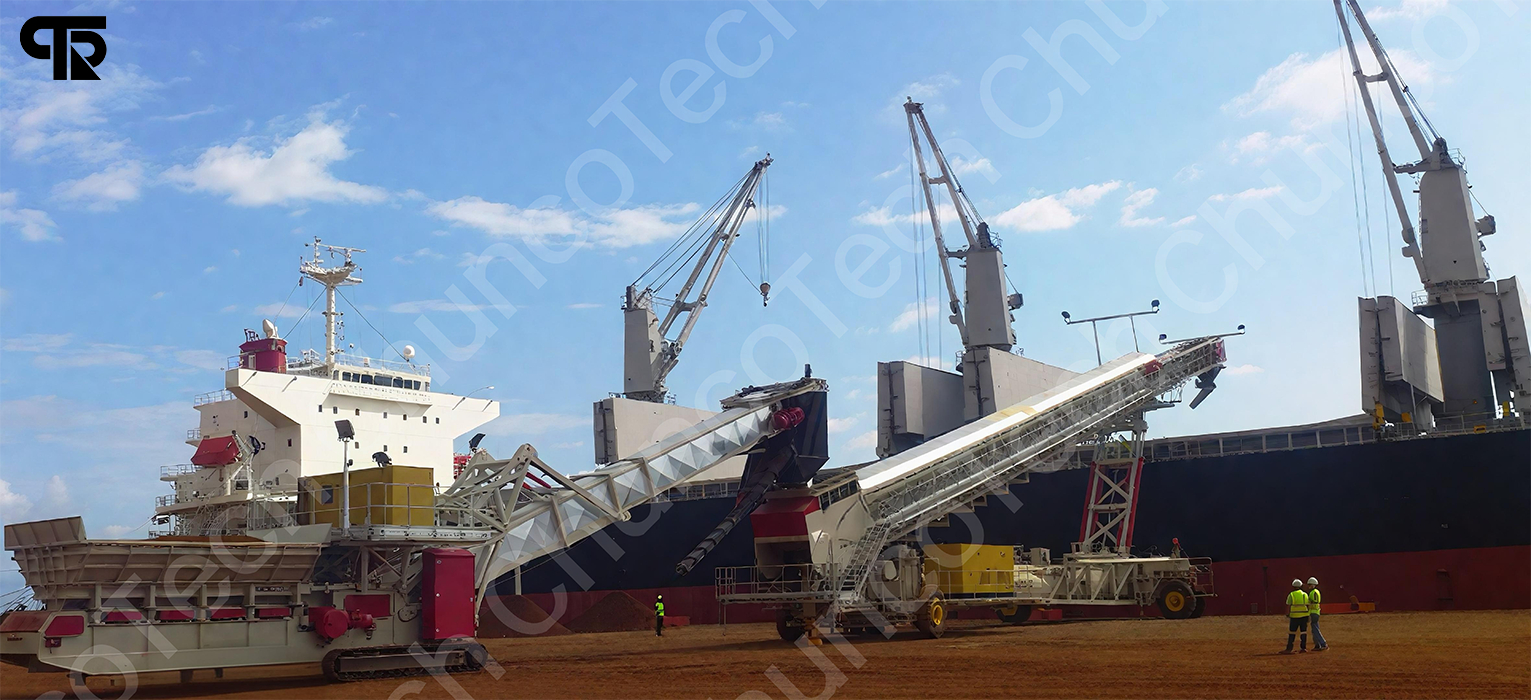
Choosing Wuxi ChuncoTech means you receive not just a mobile belt conveyor, but a mature solution validated by multiple large-scale bulk cargo terminal and yard projects. All our products are mature models already in volume production with highly reliable travel and conveying systems. Whether you need flexible transfer equipment for a bulk cargo terminal or a rapid conveying channel for a temporary stockyard, please visit our website at https://www.chuncotech.com/ to obtain a professional solution for efficient bulk cargo transfer.