
Following our previous article, "Ship Unloaders Use Continuous and Efficient Operation to Become the 'Steel Giant Stomach' for Unlocking the Unloading Process at Bulk Cargo Terminals," we have already seen how ship unloaders, at ore, coal, grain, and other bulk cargo terminals, transfer cargo from ship holds to rear yards at rates of thousands of tons per hour. However, logistics is never one-way – when cargo needs to be transported from land to sea, the loading process also faces an "efficiency bottleneck" : bulk cargo arriving by train or truck piles up at the dock, loading speeds are slow, vessels wait in line, and demurrage costs remain high. Unloading is "in," loading is "out" – if either end becomes a bottleneck, the entire supply chain is disrupted.
The ship loader is the specialized equipment designed precisely to solve this "loading bottleneck." Specifically designed for bulk materials such as coal, ore, grain, fertilizer, and cement, it transfers cargo from the rear yard and loads it into ship holds in a continuous, efficient, low-damage manner. However, many ship loaders on the market suffer from chronic issues such as "jerky boom telescoping, difficulty positioning the spout to the hold, severe dust emissions, and unstable loading efficiency," turning what should be a smooth, one-pass loading operation into a "stop-and-go" struggle. Wuxi ChuncoTech's answer is: A true "steel dragon" is not "how fast the belt runs," but rather "how much net cargo is loaded per unit time, how short the hold-positioning time is, and how low the energy consumption is per ton of cargo."
The "Steel Dragon" of Bulk Cargo Terminals
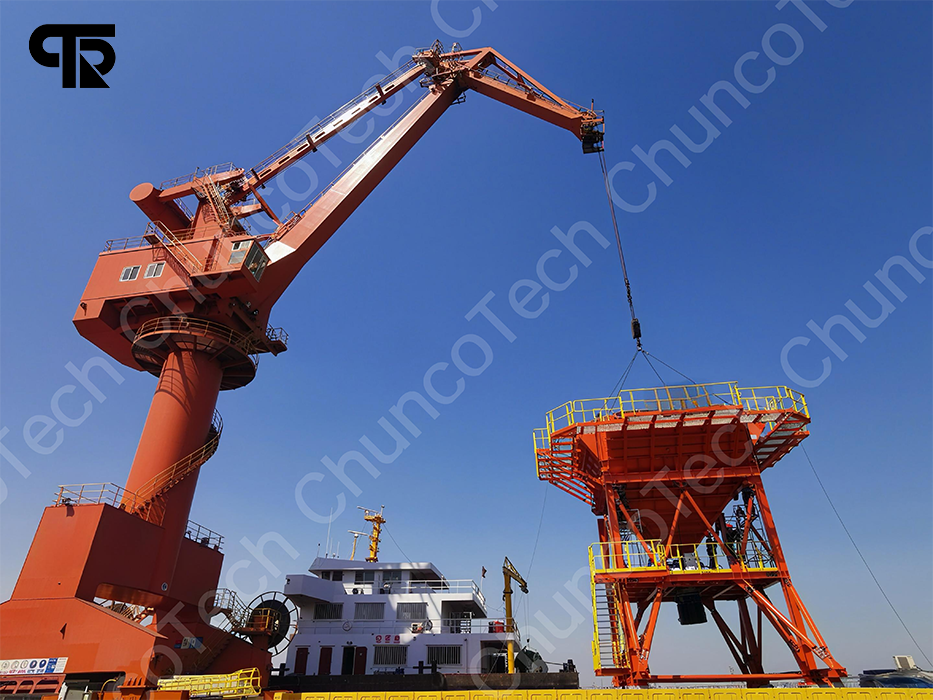
A ship loader (full name: bulk cargo ship loader) consists primarily of a portal frame or traveling bogie, slewing mechanism, luffing boom system, telescoping boom or telescoping spout, belt conveying system, and operation control system. Opposite in direction to ship unloaders which go "from ship to shore," ship loaders perform the task of "from shore to ship." They typically travel along rails on the dock, with a boom that can luff, slew, and telescope, receiving material from the rear-yard belt conveyor and transferring it continuously and uniformly into the ship's hold via the boom belt conveyor and telescoping spout.

The core value of a ship loader lies in this: It is not designed for "point-to-point lifting," but rather for "continuous, uniform, high-flow-rate ship loading." A large slewing ship loader can achieve a loading rate of 2,000 to 6,000 tons per hour – equivalent to loading two railroad cars' worth of cargo per minute. Continuous operation at this magnitude demands extremely high standards in terms of the boom belt conveyor's anti-misalignment capability, the telescoping spout's wear resistance, the machine's hold-positioning accuracy, and dust control. In the design and manufacturing of ship loaders, Wuxi ChuncoTech takes loading efficiency optimization, precise spout-to-hold positioning, and dust control and energy saving as its three core technical areas.
Solving the Three "Efficiency Killers"
In the use of ship loaders, operators and terminal managers are most frustrated by three things: difficulty positioning the telescoping spout into the hold, with repeated adjustments wasting time; severe dust emissions during loading, causing environmental non-compliance and high material loss; and unstable loading efficiency that struggles to reach rated capacity, leading to long vessel turnaround times.
1.Telescoping Spout and Precise Hold-Positioning Technology: The hold-positioning accuracy of a ship loader directly determines loading efficiency and vessel berth time. We use a multi-stage telescoping spout design with a telescoping stroke of 8 to 15 meters, adapting to different vessel types and tidal variations. The spout head is equipped with illuminated cameras and material level sensors, allowing the operator to clearly see the material surface inside the hold from the cab. The semi-automatic or fully automatic hold-positioning system uses laser scanning or radar measurement to automatically identify the hold's position and dimensions, plan the optimal loading path, and achieve one-button hold positioning and automatic loading.
2.Coordinated Control of Boom Luffing, Slewing, and Telescoping: A ship loader needs to cover a wide area within the narrow quayside. The coordination of the boom's luffing, slewing, and telescoping actions is critical. We use a full variable frequency control system and proportional hydraulic control to achieve synchronized linkage or independent fine motion of all three actions – shock-free, creep-free, and jam-free. The boom luffing angle range is typically -5 degrees to +15 degrees, the slewing angle can reach ±90 degrees or even ±180 degrees, and the telescoping stroke is 6 to 12 meters. The coordination of these three actions ensures that the spout head can precisely reach every corner of the hold.
3.Anti-Misalignment and Dust Suppression Technology: Belt misalignment and dust emissions are two major "chronic problems" of ship loaders. We use anti-misalignment idler sets and automatic alignment devices, combined with real-time belt tension monitoring and adjustment, to ensure that the boom belt conveyor operates stably for long periods without misalignment. For dust suppression, the telescoping spout head features a double-seal structure and a negative-pressure dust extraction port, so that when material falls from the spout into the hold, almost no visible dust is generated. For materials that are particularly prone to dust generation, an optional dry fog dust suppression system or dust collector is available, meeting the strictest environmental emission standards.
From Coal to Grain: The "All-Material" Coverage of Ship Loaders
Wuxi ChuncoTech's ship loaders are widely used at large coal terminals, ore terminals, grain terminals, fertilizer terminals, and cement and clinker terminals. By structural type, they are mainly divided into slewing ship loaders (large coverage range, high flexibility, suitable for medium and large terminals) and linear luffing ship loaders (simple structure, lower cost, suitable for small terminals or dedicated berths). Compared to ship unloaders, the ship loader has specialized bulk cargo loading process, high-efficiency continuous loading, precise spout-to-hold positioning, and dust control as its core advantages. Together, they form the complete "in and out" logistics loop for bulk cargo terminals. When ship unloaders handle "import" and ship loaders handle "export," Wuxi ChuncoTech builds for its customers a complete bulk cargo terminal equipment system ranging from unloading to loading, from import to export, from continuous conveying to precise hold positioning.
Choosing Wuxi ChuncoTech means you receive not just a ship loader, but a mature solution validated by multiple large-scale bulk cargo terminal projects. All our products are mature models already in volume production with highly reliable processes and structures. Whether you need a large slewing ship loader for a new coal export terminal or a high-efficiency loading solution for a grain terminal, please visit our website at https://www.chuncotech.com/ to obtain a professional solution for efficient bulk cargo ship loading.