
Following our previous article, "When 'National Heavy Equipment' Defines the Manufacturing Ceiling, How Do Giant Gantry Cranes Support the Skies of Ultra-Large Engineering Projects?" we have already seen how giant gantry cranes, with their ultra-large spans and intelligent load equalization, precisely position thousand-ton components in extreme manufacturing scenarios such as shipyards and nuclear power bases. However, when we shift our focus from "manufacturing" to "port logistics" – hundreds of millions of tons of bulk cargo such as iron ore, coal, grain, and cement are transferred from ships to land through ports every year – a distinctly different efficiency problem emerges: bulk cargo ship unloading is the most likely "bottleneck" in the entire supply chain. A single day of vessel demurrage can cost tens of thousands; low unloading efficiency leaves the rear yard "waiting for delivery."
The ship unloader is the specialized equipment designed precisely to solve this "bulk cargo unloading bottleneck." Specifically designed for bulk materials such as coal, ore, grain, and fertilizer, it grabs cargo from ship holds and transfers it to the dock's belt conveyor system in a continuous, efficient, low-loss manner. However, many ship unloaders on the market suffer from chronic issues such as "large grab swing, unstable unloading efficiency, poor dust control, and high maintenance costs," turning what should be "smooth and flowing" unloading operations into a series of jolts and delays. Wuxi ChuncoTech's answer is: True unloading efficiency is not "how fast the grab opens and closes," but rather "how much net cargo is unloaded per unit time, how low the energy consumption is per ton of cargo, and how high the equipment availability is."
The "Steel Giant Stomach" of Bulk Cargo Terminals
A ship unloader (full name: bulk cargo ship unloader) consists primarily of a portal frame, boom system, grab or continuous ship unloading device, trolley travel mechanism, belt conveying system, and operation control system. Unlike general-purpose portal slewing cranes, the ship unloader is a specialized piece of equipment tailored for the specific process of bulk cargo ship unloading. It typically travels along rails on the dock, with a boom that can luff and slew. After the grab picks up bulk cargo from the ship's hold, the trolley moves to transfer the material to a hopper on the portal frame, from where feeders and belt conveyors deliver the cargo continuously to the rear yard or directly onto trucks.
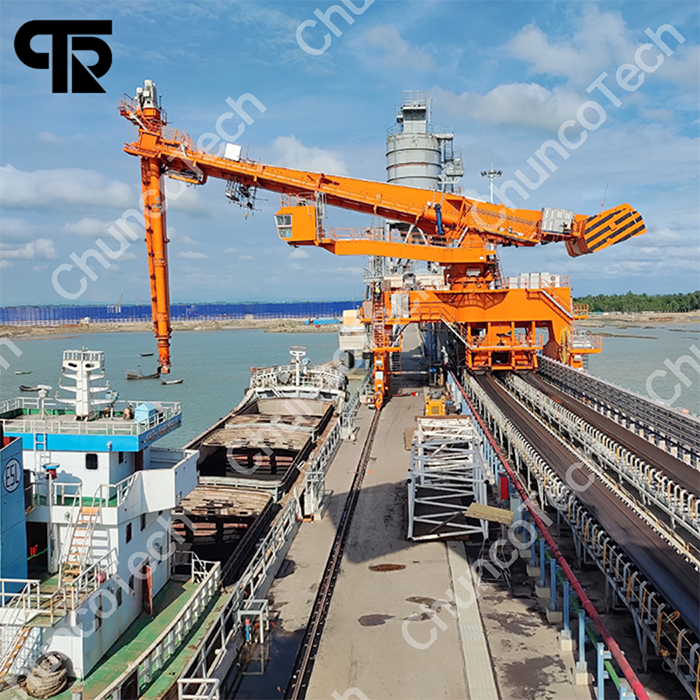
Compared to the various types of cranes introduced in the previous thirteen articles, the core differentiating value of a ship unloader lies in this: It is not designed for "general cargo lifting," but rather for "efficient continuous unloading of bulk materials." A large bridge-type grab ship unloader can achieve an unloading rate of 1,500 to 3,000 tons per hour – equivalent to unloading a railroad car's worth of cargo every minute. Operations at this magnitude demand extremely high standards in terms of grab wear resistance, trolley acceleration/deceleration performance, hopper buffering capacity, and overall equipment reliability. In the design and manufacturing of ship unloaders, Wuxi ChuncoTech takes unloading efficiency optimization, grab anti-sway and positioning, and dust control and energy saving as its three core topics, ensuring that every piece of equipment is a bulk cargo terminal workhorse that "unloads quickly, consumes less, and stops reliably."
Solving the Three "Efficiency Killers" of Ship Unloaders
In actual use, ship unloader operators and terminal managers are most frustrated by three things: large grab swing leading to difficult hold targeting and severe spillage; unstable unloading efficiency that struggles to reach rated capacity; and high equipment failure rates with long repair times, affecting vessel turnaround. Wuxi ChuncoTech makes these "efficiency killers" disappear with the following three core technologies:
1.Grab Anti-Sway and Intelligent Positioning Technology: The swing of the grab during hoisting, trolley travel, and boom slewing is the main obstacle to unloading efficiency and safety. We employ an electronic anti-sway system that uses variable frequency speed control and speed curve optimization, combined with real-time feedback from grab attitude sensors, to control grab swing amplitude within ±50 millimeters. At the same time, an intelligent grab positioning system uses laser scanning or radar measurement to automatically identify material distribution inside the hold, plan the optimal grabbing path, and achieve semi-automatic or fully automatic grabbing – significantly reducing operator fatigue and improving cycle efficiency.
2.Continuous Unloading and Smooth Material Flow Technology: The core of unloading efficiency lies in "smooth passage" of material from the grab to the hopper to the belt conveyor. Our hopper features a large buffer volume design (typically 20-40 cubic meters) , lined with wear-resistant liners (such as NM400 or ceramic liners) to effectively absorb the impact of grab discharge. Vibrating feeders or chain-plate feeders are speed-matched to the belt conveyor, ensuring uniform and continuous material flow, avoiding belt misalignment or material jams caused by "surges." For materials prone to clogging, optional hopper arch-breaking devices or air cannons completely solve the blockage problem.
3.Overall Equipment Reliability and Maintenance Convenience Design: Ship unloaders operate year-round without rest – any unscheduled downtime results in huge losses. Wuxi ChuncoTech integrates reliability design throughout: the grab uses high-wear-resistant alloy lips and replaceable teeth; key pivot points use maintenance-free bearings or centralized lubrication systems; wire ropes feature online monitoring and automatic lubrication. The electrical system uses redundant PLCs and modular design, with a fault diagnosis system that monitors each mechanism in real time and provides early warnings of potential failures. Maintenance access ways, inspection platforms, and lifting points are integrated into the design, significantly reducing repair time and increasing equipment availability to over 98%.
From Ore to Grain: The "All-Material" Coverage of Ship Unloaders
Wuxi ChuncoTech's ship unloaders are widely used at large ore terminals (iron ore, bauxite), coal terminals, grain terminals (soybeans, corn, wheat), fertilizer terminals, and cement and clinker terminals. By structural type, they are mainly divided into bridge-type grab ship unloaders (suitable for various bulk cargoes, with high efficiency and strong adaptability) and continuous ship unloaders (suitable for less abrasive materials such as coal and grain, with smoother efficiency and less dust). Compared to the portal slewing cranes introduced in the second article (used for general cargo lifting), the ship unloader has specialized bulk cargo unloading process, high unloading efficiency, low energy consumption per ton of material, and grab anti-sway and intelligent positioning as its core advantages, filling the gap for "efficient bulk cargo ship unloading" needs. When portal slewing cranes handle "general cargo" and ship unloaders handle "bulk cargo," Wuxi ChuncoTech builds for its customers a complete port logistics equipment system ranging from general cargo to bulk cargo, from lifting to continuous conveying.
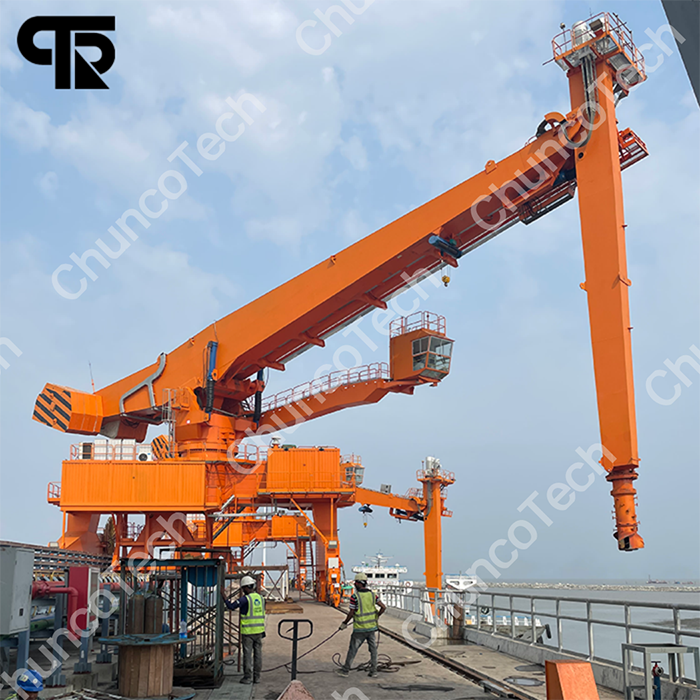
Choosing Wuxi ChuncoTech means you receive not just a ship unloader, but a mature solution validated by multiple large-scale bulk cargo terminal projects. We have no uncertainty from R&D trial-and-error; all our products are mature models already in volume production with highly reliable processes and structures. Whether you need a large bridge-type grab ship unloader for a new ore terminal, a high-efficiency continuous ship unloader for a grain terminal, or a ship unloader upgrade and retrofit for an old terminal, please visit our website at https://www.chuncotech.com/ to obtain a professional solution for efficient bulk cargo ship unloading.