
Following our previous article, "When 'All-Round Coverage' Becomes the Source of Efficiency, How Do Portal Slewing Cranes Build the 'Golden Corridor' Between Docks and Yards?" we have already seen how portal slewing cranes, with their slewing and luffing capabilities, create a "golden corridor" for cargo transfer between the quayside and the rear yard. However, when operational scenarios shift from "land and dock" to "water surface and dry dock" – equipment lifting during ship docking for repair, section assembly on floating docks, outfitting operations on offshore platforms, large equipment installation inside dry docks – a fundamental question emerges: Conventional land-based cranes cannot move with the ship, and fixed shipyard cranes cannot reach every corner of a floating dock.
The floating dock crane (also known as a dockyard crane or floating portal crane) is the specialized equipment designed precisely for this "floating platform" demand. It is installed directly on the wing walls or deck of a floating dock, rising, submerging, heeling, and trimming together with the floating dock – performing stable lifts on an unstable platform. However, many floating dock cranes on the market suffer from shortcomings such as "insufficient anti-heel capacity, poor corrosion resistance, and difficult positioning under floating conditions," turning what should be efficient ship repair into a series of struggles. Wuxi ChuncoTech's answer is: True "over-water operation" is not "just lifting casually on calm water," but rather "remaining rock-solid through the complex dynamics of floating dock ascent, ship blocking, and tidal changes."
Lifting as Usual, on a Floating Platform
A floating dock crane shares a similar structure to a portal slewing crane, but the greatest difference lies in the installation foundation – it is not fixed to a solid concrete dock or ground, but rather installed on the steel wing walls or deck rails of a floating dock. The floating dock itself is a submersible and liftable floating platform used to raise ships out of the water for repair or construction. This means that the floating dock crane must maintain stable lifting capacity and precise controllability in the dynamic environment of platform tilting, swaying, and rising/submerging.
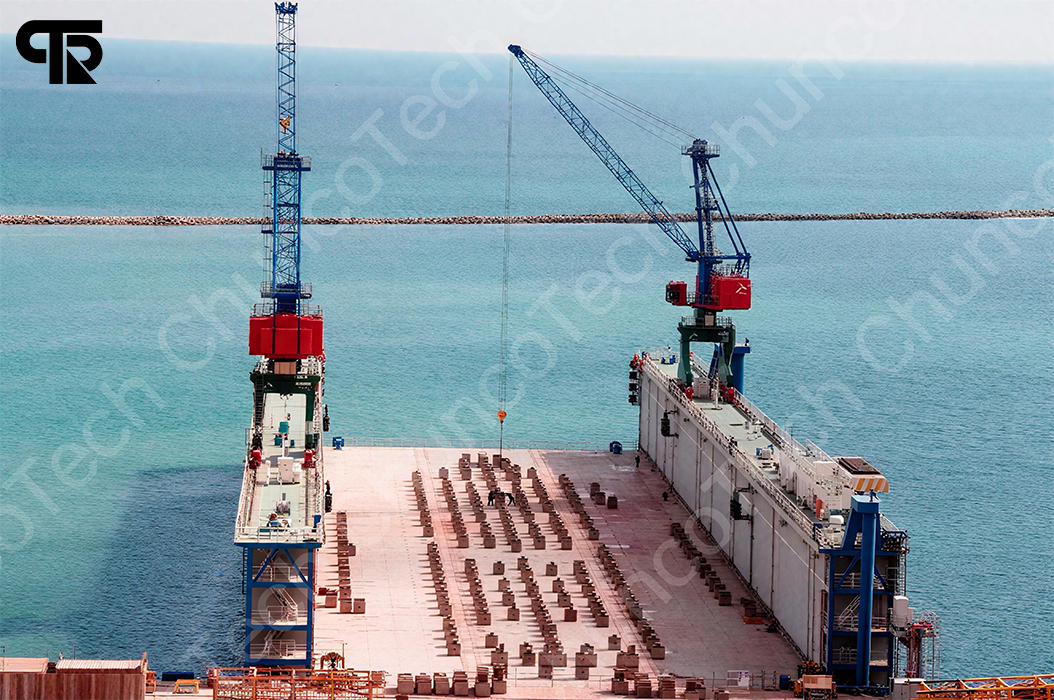
Compared to the various types of cranes introduced in the previous eleven articles, the core differentiating value of a floating dock crane lies in this: It is not designed for "fixed foundations," but rather for "floating platforms." When a ship enters a floating dock, the dock – along with the crane mounted on it – rises together, lifting the ship out of the water. Throughout this process, the crane's center of gravity, stability, and overturning resistance dynamically change with the dock's attitude. An excellent floating dock crane must not only operate efficiently on calm water, but also lift stably, slew smoothly, and stop precisely under the complex conditions of dock ascent, ship shifting, and tidal fluctuations. In the design and manufacturing of floating dock cranes, Wuxi ChuncoTech takes floating stability calculation, corrosion-resistant material application, and dynamic anti-sway control as its three core topics, ensuring that every piece of equipment is "combat-ready on water and stable even when floating."
Solving the Three "Floating Challenges" of Floating Dock Cranes
In actual use, operators and managers of floating dock cranes worry most about three things: center of gravity shift during dock ascent or submersion, leading to overturning risk; salt spray corrosion from long-term over-water operation, reducing structural strength and electrical reliability; and exacerbated load sway under floating conditions, making precision positioning difficult. Wuxi ChuncoTech solves these "floating challenges" with the following technologies:
1.Floating Stability and Anti-Overturning Design: The stability of a floating dock crane depends not only on its own structure but also on the floating dock's draft depth, heel angle, and trim angle. We perform multi-condition stability calculations, simulating the crane's center of gravity distribution under different loads, water levels, and tilt angles, ensuring that under all expected operating conditions, the stability coefficient meets and exceeds international classification society rules. For ultra-large-tonnage floating dock cranes, we offer an optional active balance system that adjusts counterweights or reaction forces in real time to compensate for overturning moments caused by dock attitude changes.
2.Full Corrosion Protection and Marine Environment Adaptability Technology: Salt water, humidity, and UV radiation are the "three natural enemies" of floating dock cranes. We adopt C5-M grade corrosion protection design (the highest marine corrosion protection level), with steel surface treatment achieving Sa2.5 blast cleaning standard, paired with a multi-layer coating system of epoxy zinc-rich primer + epoxy micaceous iron oxide intermediate + polyurethane topcoat, with a total dry film thickness of not less than 320 microns. Key electrical components are rated IP65 or higher, cables are marine-grade oil-resistant and salt-spray-resistant, and control cabinets are equipped with positive pressure ventilation or heat exchangers to prevent salt spray ingress. A Wuxi ChuncoTech floating dock crane can operate stably in marine environments for more than 20 years.
3.Dynamic Anti-Sway and Floating Precision Positioning Technology: The residual sway of the floating dock and wave excitation amplify the load's swing amplitude. We equip our cranes with an active electronic anti-sway system that uses an Inertial Measurement Unit (IMU) to monitor the dock's and spreader's attitude in real time, combined with predictive control algorithms, actively applying counter-torque during hoisting, slewing, and luffing actions to control load swing amplitude within ±30 millimeters. At the same time, the micro-motion mode under floating conditions allows operators to achieve millimeter-level inching precision positioning even while the floating dock is swaying.
From Ship Repair to Offshore Engineering: The "Water Domain" of Floating Dock Cranes
Wuxi ChuncoTech's floating dock cranes are widely used in ship repair and conversion floating docks, section assembly on floating docks, outfitting and lifting of offshore platform modules, large equipment installation inside dry docks, and lightering operations between floating docks. Compared to the portal slewing cranes introduced in the second article (which are fixed to solid dock surfaces), the floating dock crane has floating platform adaptability, full corrosion protection design, and dynamic anti-sway as its core advantages, filling the gap for "over-water floating platform lifting" needs. When portal slewing cranes handle "dock to yard" and floating dock cranes handle "floating dock to ship," Wuxi ChuncoTech builds for its customers a complete lifting capability map ranging from land to water, from fixed to floating, from ship repair to offshore engineering.
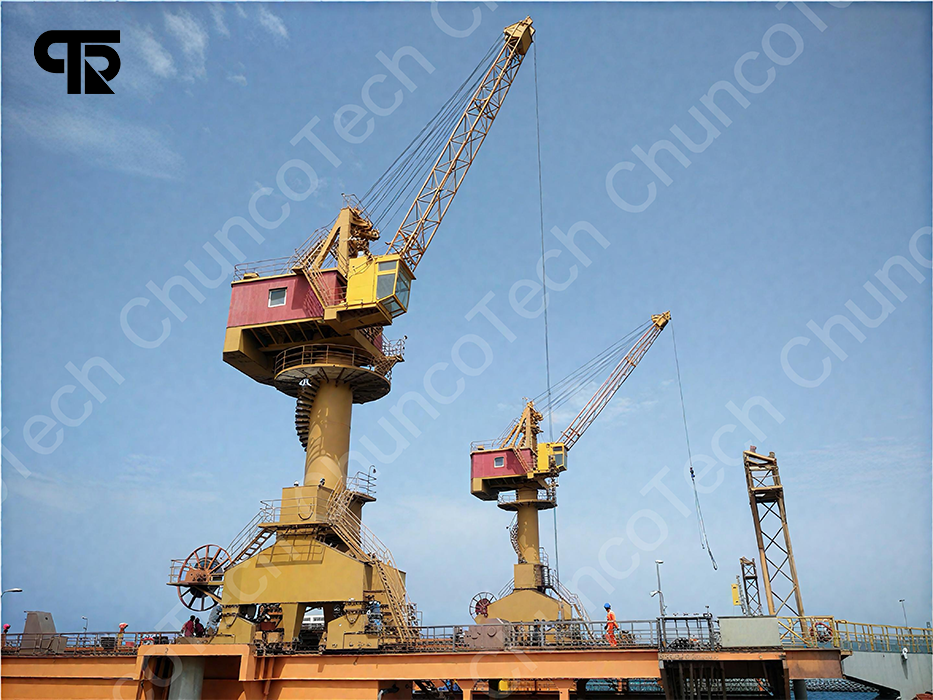
Choosing Wuxi ChuncoTech means you receive not just a floating dock crane, but a mature solution validated by multiple large-scale ship repair yard and offshore engineering base projects. We have no uncertainty from R&D trial-and-error; all our products are mature models already in volume production with highly reliable corrosion protection and stability design. Whether you need a dockyard crane for a ship repair floating dock, a large floating crane for an offshore construction base, or a customized floating dock crane for a floating dock upgrade and retrofit, please visit our website at https://www.chuncotech.com/ to obtain a professional solution for over-water floating platform lifting.