
Following our previous article, "When 'Heavy Load at Long Radius' Becomes a Hard Requirement, How Do Stiff Boom Cranes Conquer Extreme Conditions with a 'Never-Sag' Attitude?" we have already seen how stiff boom cranes, with their high lattice boom rigidity and long-radius lifting capacity, conquer extreme conditions where other equipment "can reach but cannot lift" – in wind farms, bridge construction, and other scenarios. However, when operational scenarios shift from "point-type extreme conditions" back to "linear continuous operations" – from quayside to rear yard, from ship unloading to truck loading, from cargo reception to yard transfer – the question is no longer "how far can a single lift reach," but rather "on a single operation line, can it efficiently, continuously, and fully cover every inch of space."
The portal slewing crane (also known as a wharf crane or level luffing crane) is the absolute workhorse in this "linear continuous operation" scenario. With both a portal structure that allows trains and trucks to pass through and a slewing mechanism that provides 360-degree full coverage, it is one of the most frequently seen pieces of equipment at ports, docks, shipyard outfitting wharves, and yard transfer operations. However, many portal slewing cranes on the market suffer from chronic issues such as "stiff slewing, jerky luffing, and low efficiency in multi-mechanism coordination," turning what should be smooth, flowing operations into a series of jolts and delays. Wuxi ChuncoTech's answer is: True efficiency is not "how fast a single action is," but rather "hoisting, luffing, slewing, and traveling – four actions flowing together like a seamless river."
Above the Portal, Turning the World
A portal slewing crane is most notably characterized by its portal frame structure – the portal. Freight vehicles (such as container trucks and trains) can pass freely under the portal, achieving seamless integration of "ship unloading, under-portal passage, and rear yard stacking." Above the portal frame is mounted a turntable capable of 360-degree full slewing, carrying the jib, operator's cab, hoisting mechanism, and other components, expanding the crane's working range from a single "point" or "line" to a huge fan-shaped or even circular area.
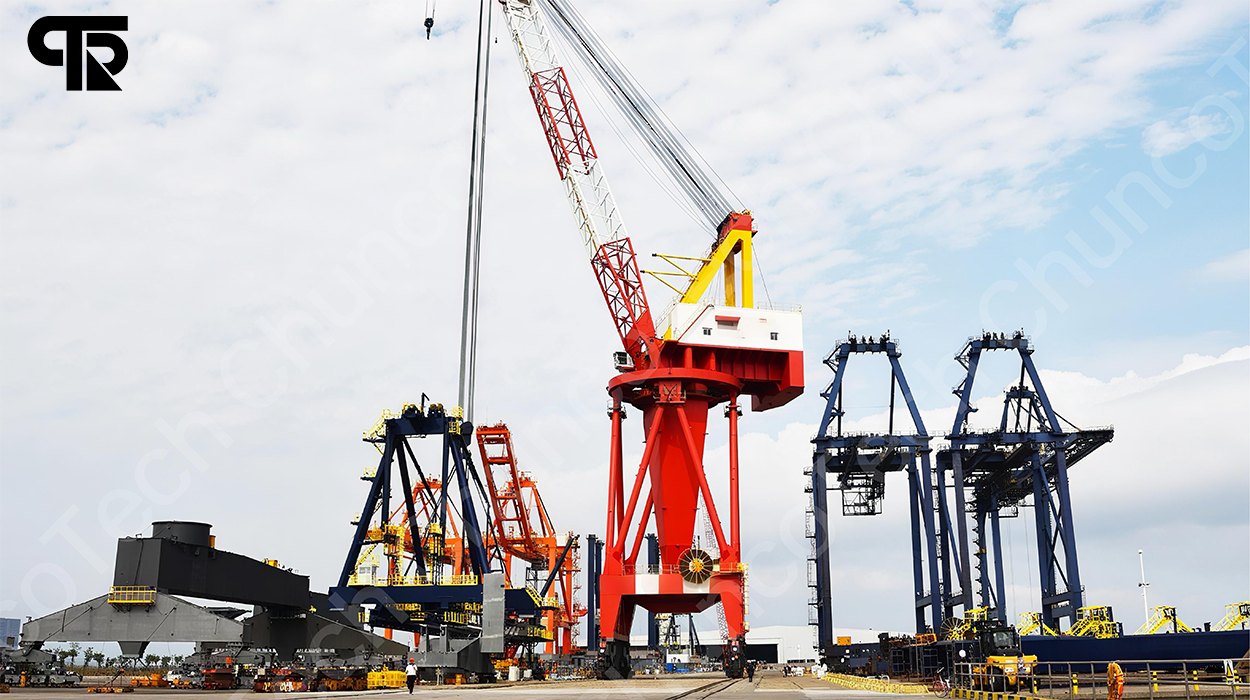
Compared to the various types of cranes introduced in the previous ten articles, the core differentiating value of a portal slewing crane lies in this: It is not designed for "single actions" or "extreme conditions," but rather for "high-frequency, continuous, multi-action compound operations between docks and yards." A typical working cycle of a portal slewing crane is: hoist to grasp cargo → slew to above the portal → luff to adjust landing point → lower to release cargo → reverse slew → hoist again. In this cycle, the overlap and coordination of these four actions determine the crane's overall operational efficiency. In the design and manufacturing of portal slewing cranes, Wuxi ChuncoTech takes mechanism matching, electronic control coordination, and structural durability as its three core topics, ensuring that every crane "slews smoothly, hoists quickly, stops precisely, and lasts long."
Solving the Three "Efficiency Killers" of Portal Slewing Cranes
In actual use, operators and managers of portal slewing cranes are most frustrated by three things: the slewing mechanism "fighting back," with severe impact during start and brake under heavy loads; the luffing action "nodding," with the load rising and falling significantly during luffing; and the four mechanisms – hoisting, luffing, slewing, and traveling – "working independently," unable to perform compound actions, lengthening cycle times. Wuxi ChuncoTech makes these "efficiency killers" disappear with the following technologies:
1.Heavy-Load Slewing and Smooth Drive Technology: The slewing mechanism of a portal slewing crane withstands enormous overturning moment and inertial loads. We use three-row roller slewing rings paired with hydraulic slewing motors or variable frequency electric drives to achieve smooth start, uniform rotation, and precise braking under heavy loads. The slewing drive system is equipped with slewing cushion valves and anti-sway control algorithms that automatically optimize torque output during start and stop phases, eliminating "nodding" and "fishtailing," keeping the load level and stable throughout the slew.
2.Luffing Compensation and Horizontal Load Displacement Control Technology: On conventional portal slewing cranes, during luffing, the hook experiences significant vertical rise and fall as the jib angle changes – known as luffing drop. This not only affects efficiency but also poses safety hazards. Wuxi ChuncoTech's portal slewing cranes come standard with a luffing compensation system, achieving horizontal displacement of the hook during luffing through differential design of the wire rope drum or electronic compensation algorithms, with almost no vertical load fluctuation. Operators can perform luffing operations boldly and continuously without repeatedly fine-tuning the hoisting height.
3.Multi-Mechanism Coordination and Compound Action Technology: The key to efficiency is time overlap. We use a PLC-based full variable frequency control system that supports simultaneous or selective compound actions of all four mechanisms – hoisting, luffing, slewing, and traveling. Operators can hoist or luff while slewing, with all four actions operating independently and executed in overlap. An optimized Wuxi ChuncoTech portal slewing crane can reduce single-cycle operation time by 20% to 30% compared to conventional equipment – meaning more annual throughput and greater operational revenue.
From Docks to Shipyards: The "Full-Scene" Coverage of Portal Slewing Cranes
Wuxi ChuncoTech's portal slewing cranes are widely used in general cargo and bulk cargo handling at ports and docks, large section lifting at shipyard outfitting wharves, container and steel transfer at rail freight stations, and large-component handling in storage yards. Unlike the portal slewing crane introduced in the second article (which focused on basic structure and precision), this article provides a deeper interpretation from the new perspectives of "efficiency" and "multi-mechanism coordination." When giant gantry cranes handle "extreme tonnage inside dry docks," stiff boom cranes handle "extreme radius heavy loads," and portal slewing cranes handle "the golden corridor from docks to yards," Wuxi ChuncoTech builds for its customers a complete lifting capability map ranging from dry docks to docks, from yards to workshops, from conventional to extreme.
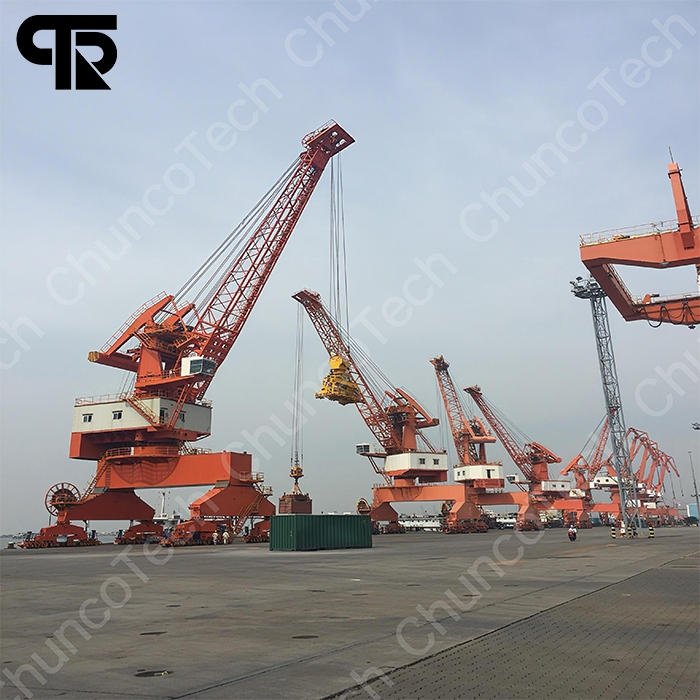
Choosing Wuxi ChuncoTech means you receive not just a portal slewing crane, but a mature solution validated by hundreds of port and shipyard projects. We have no uncertainty from R&D trial-and-error; all our products are mature models already in volume production with highly matched four mechanisms. Whether you need a high-efficiency portal slewing crane for a new container terminal or an upgrade and retrofit for an old port, please visit our website at https://www.chuncotech.com/ to obtain a professional solution for efficient dock-to-yard lifting.