
Following our previous article, "Lifting 'Giants' Only Possible with Ground Equipment? Wuxi ChuncoTech Overhead Cranes Make Aerial Lifting Equally Effortless," we have already seen how overhead cranes suspended from the roof, with their three-dimensional motion capabilities, cover every corner of a standard rectangular space in heavy assembly workshops and nuclear power plant buildings. However, real-world operating scenarios are far more complex than "standard rectangular workshops" – next to machine tools in machining workshops, inside hatchways in shipyards, between beams and columns of steel structures, at the edges of truck unloading platforms – spaces are often narrow, irregular, and lacking any rails or columns for installing traditional lifting equipment. In these "tight spots," workers often have to rely on forklifts, manual chain hoists, or even brute force to complete tasks – resulting in low efficiency and numerous safety hazards.
This is where the jib crane becomes the undisputed choice. With its simple structure, minimal footprint, and flexible installation, it solves workstation-level, tooling-level daily lifting challenges with "one-person operation and effortless lifting." However, many jib cranes on the market suffer from common problems such as "stiff slewing, sagging under heavy load, and difficult positioning," turning what should be a "handy" tool into a frustrating burden. Wuxi ChuncoTech's answer is: True convenience is not "having something is better than nothing," but rather "smooth to use, seamless to slew, and stable to lift."
Lifting Freedom Supported by a Single Column
A jib crane consists of four components: the column, the jib arm, the hoist, and the slewing mechanism. The column is fixed to the floor or wall, the jib arm slews 180, 270, or 360 degrees around the column, and the hoist moves horizontally along the I-beam of the jib arm. This combination of "jib slewing plus hoist traveling" allows the crane to cover a fan-shaped or circular work area.
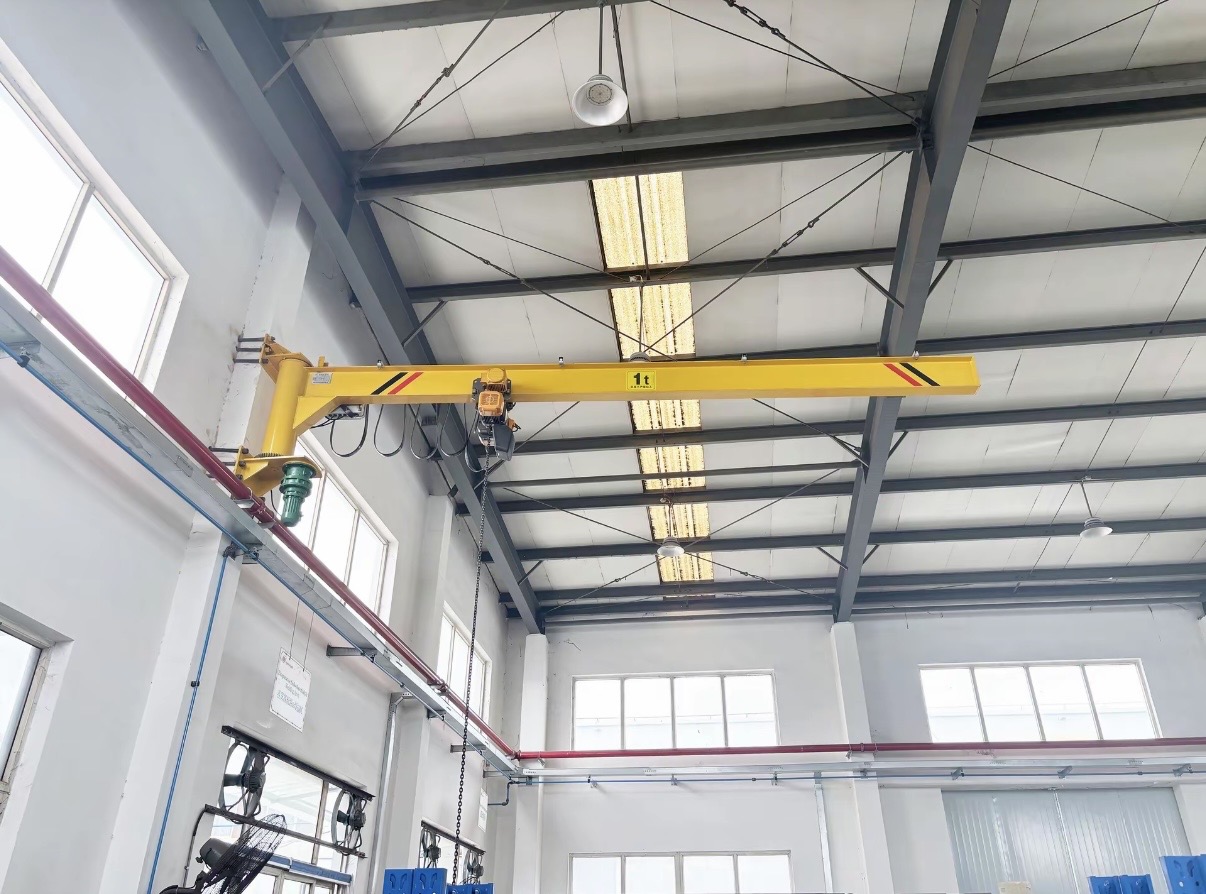
Compared to the large lifting equipment introduced in the previous four articles (giant gantry cranes, portal slewing cranes, rubber-tired gantry cranes, and overhead cranes), the unique value of a jib crane lies in this: It is not designed for "whole-plant coverage," but rather for "single-point breakthrough." It does not pursue lifting capacities of hundreds of tons nor spans of hundreds of meters. Instead, it focuses on solving workstation-level, high-frequency, space-constrained daily lifting needs. A well-designed jib crane allows one worker to easily complete material handling tasks that would otherwise require three or four people to coordinate – significantly reducing labor intensity, improving operational efficiency, and lowering the risk of workplace injuries.
Solving the Three Major Workstation Problems: "Won't Slew," "Won't Lift Steadily," and "Won't Align"
In workstation-level lifting scenarios, operators are most annoyed by three things: the jib arm jerking and sticking during slewing, the jib arm visibly bending downward when lifting heavy loads (causing anxiety), and the hoist "swinging around" when precise positioning is needed to align with threaded holes. Wuxi ChuncoTech eliminates these problems with the following technologies:
1.Heavy-Load Slewing and Smooth Rotation Technology: The root cause of slewing sticking is improper bearing selection and insufficient machining precision. We use high-precision slewing rings combined with plain bearings or tapered roller bearings to ensure that even under rated load limits, the jib arm can be easily pushed with one hand, rotating smoothly without sticking. At the same time, the adjustable slewing damping design allows users to freely choose the rotation "tightness" based on working conditions, preventing both "creeping" under light loads and "being unable to push" under heavy loads.
2.Jib Rigidity and Anti-Sagging Design: Deflection deformation of the jib arm under heavy loads not only affects visual perception but also directly impacts the horizontal positioning accuracy of the lifted load. Wuxi ChuncoTech's jib arms use variable-section I-beams or box girders, optimized through finite element analysis, to achieve maximum rigidity while keeping weight to a minimum. Under 125% static load testing, the deflection at the jib end is far superior to national standards, giving operators "visual confidence and operational peace of mind."
3.Hoist Travel and Precision Positioning Technology: The hoist on the jib arm needs to move horizontally along the jib. In traditional designs, uneven rails or hoist wheel slippage can cause "off-track" and "difficult positioning." We use precision cold-drawn I-beam rails and nylon traveling wheels, resulting in low travel resistance, low noise, and no rail damage. Paired with a variable frequency controlled hoist, we achieve stepless speed control and millimeter-level jogging. Whether feeding a workpiece into a machine tool table or aligning a mold with bolt holes, it achieves "one-time positioning."
From Workshops to Warehouses: The Ubiquitous "Workstation Assistant"
Wuxi ChuncoTech's jib cranes are widely used in machining workshops, assembly line stations, mold shops, heat treatment workshops, dockside areas, truck unloading platforms, warehouse aisleways, and small-component lifting on construction sites. Compared to the large-span overhead cranes covering entire workshops discussed in the previous article, the jib crane has minimal footprint, quick installation, and low investment as its core advantages, filling the gap for workstation-level, high-frequency, scattered lifting needs. When the overhead crane handles "plant-wide coverage" and the jib crane handles "every workstation," Wuxi ChuncoTech builds for its customers a complete lifting capability map ranging from "macro" to "micro," from "whole plant" to "workstation."
Choosing Wuxi ChuncoTech means you receive not just a jib crane, but a mature solution validated by thousands of units of mass production. We have no uncertainty from R&D trial-and-error; all our products are mature models already in volume production, ready for immediate use. Whether you need a column-mounted jib crane next to a machine tool, a wall-mounted jib crane for a warehouse wall, or a portable jib crane for container operations, please visit our website at https://www.chuncotech.com/ to obtain a professional solution for workstation-level flexible lifting.