
Following our previous article, "No Rails Needed to 'Lift Heavy as If Light'? Wuxi ChuncoTech Rubber-Tired Gantry Cranes Bring Flexible Lifting Everywhere," we have already seen how rubber-tired gantry cranes, with their rail-free travel and multi-mode steering capabilities, expand the coverage of heavy-load lifting from "lines" to "areas" in storage yards, freight yards, and remote construction sites. However, when the operating environment shifts from outdoors to indoors – entering heavy machinery assembly workshops, large warehouses, hydropower station buildings, or nuclear reactor buildings – an entirely new challenge emerges: The ground space is fully occupied by equipment, workpieces, and aisles, leaving no room for cranes to move freely like outdoor equipment. At the same time, the roof and walls limit the crane's height and slewing radius. In such a "snail shell," how do you complete the lifting and positioning of precision equipment weighing hundreds or even thousands of tons?
This is the home turf of the overhead crane (also known as a bridge crane). It hangs from the roof rails of the workshop, completely freeing up all ground space, solving the problem of indoor heavy-load lifting by working "from the sky." However, common overhead cranes on the market often suffer from chronic issues such as "running off-track, rail gnawing, inaccurate positioning, and excessive vibration under heavy loads," making users anxious when installing precision equipment. Wuxi ChuncoTech's commitment is: Indoor lifting should not only "lift heavy loads" but also "place them accurately, stably, and without error."
A Steel Rainbow Spanning the Roof
An overhead crane (or bridge crane) consists of four major components: the bridge, the trolley, the bridge travel mechanism, and the electrical control system. The bridge spans across the crane rails mounted on both sides of the workshop and travels along the length of the workshop. The trolley travels along the bridge's main girder across the width of the workshop. This three-dimensional motion mode – bridge traveling longitudinally, trolley traveling laterally, and hook hoisting vertically – allows the crane to cover every position within the entire rectangular workshop.
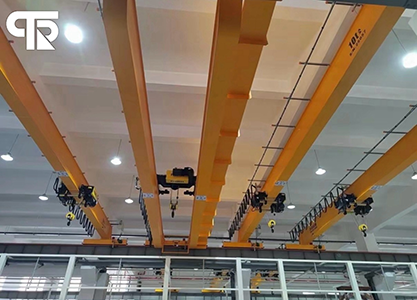
Unlike the ground-supported cranes introduced in the previous three articles (giant gantry cranes, portal slewing cranes, and rubber-tired gantry cranes), the unique feature of an overhead crane is that the entire crane's self-weight and the lifted load are transmitted through the roof rails to the workshop's columns and foundations on both sides. This means that the design of an overhead crane must consider not only its own strength and rigidity but also precisely match the workshop's crane rail beam structure. Before equipment delivery, Wuxi ChuncoTech conducts a comprehensive survey of the customer's workshop structure, rail straightness, and column settlement to ensure perfect integration between the "crane" and the "building," eliminating the awkward situation of "the crane arrives, but the building can't support it."
Solving the Three Major Indoor Lifting Problems: "Off-Track," "Rail Gnawing," and "Misalignment"
In indoor precision equipment installation scenarios, operators fear three things most: the wheels "gnawing" at the rails during bridge travel, producing harsh noises; the entire crane swaying under heavy load, making it impossible to align the load with mounting bolt holes; and cumulative "off-track" errors developing in the bridge or trolley after prolonged use. Wuxi ChuncoTech makes these problems completely disappear with the following core technologies:
1.Anti-Off-Track and Anti-Rail-Gnawing Technology: Rail deviation and wheel machining errors are the two main causes of "off-track rail gnawing" in overhead cranes. We employ a laser distance measuring correction system and independent wheel drive control, which monitor the travel distance difference between the two sides of the bridge in real time and automatically adjust the drive speeds to ensure both sides always stay synchronized. Additionally, the wheels are designed with double flanges or single flanges plus horizontal wheels, paired with precision-machined slewing rings, minimizing rail gnawing and significantly extending the service life of both rails and wheels.
2.Heavy-Load Anti-Sway and Inching Precision Positioning Technology: Overhead cranes serve scenarios such as precision assembly, equipment installation, and mold changing, where positioning accuracy requirements are far higher than those for ordinary material handling. Wuxi ChuncoTech equips its cranes with an electronic anti-sway system and variable frequency inching control. Under full load conditions, the hook's swing amplitude is controlled within ±5 millimeters. In inching mode, the jog displacement is accurate to the millimeter level. Whether lowering a hundred-ton transformer onto its designated base or maneuvering a precision machine tool component through a narrow workshop aisle, our cranes achieve "one-time positioning without repeated adjustments."
3.Overload Protection and Multiple Safety Redundancy: The enclosed indoor environment means that accidents have even more severe consequences. Wuxi ChuncoTech's overhead cranes are equipped with three-tier overload protection (electronic weighing, torque limiting, and mechanical overload limiter), as well as safety devices such as hoisting limit switches, travel limit switches, and wind anchoring devices. Critical welds undergo 100% ultrasonic flaw detection, and key shaft-type components undergo magnetic particle inspection, ensuring that the crane remains structurally intact and operates normally under a static load test of 125% of the rated capacity.
From Heavy Assembly to Nuclear Maintenance: The Universal Hand of Indoor Lifting
Wuxi ChuncoTech's overhead cranes are widely used in heavy machinery assembly workshops, power plants (hydro, thermal, and nuclear) buildings, large warehouses, aircraft manufacturing workshops, mold workshops, heat treatment workshops, and nuclear reactor buildings. Compared to the rubber-tired gantry cranes that operate in outdoor storage yards discussed in the previous article, the overhead crane has suspended structure, three-dimensional full coverage, and high-precision positioning as its core advantages, filling the technical gap for heavy-load lifting in enclosed indoor spaces. When the giant gantry crane serves the dry dock, the portal slewing crane serves the dock, the rubber-tired gantry crane serves the storage yard, and the overhead crane serves the workshop, Wuxi ChuncoTech builds for its customers a full-scenario lifting capability map covering "indoor to outdoor, land to waterfront, and rail to rail-free."
Choosing Wuxi ChuncoTech means you receive not just an overhead crane, but a mature solution validated by hundreds of projects. We have no uncertainty from R&D trial-and-error; all our products are mature models already in volume production and precisely matched to workshop structures. Whether you need a large-tonnage overhead crane for a new heavy assembly workshop or a low-headroom overhead crane for retrofitting an older workshop, please visit our website at https://www.chuncotech.com/ to obtain a professional solution for indoor heavy-load precision lifting.