
Following our previous article, "Who Says 'Brute Force' Can't Do 'Delicate Work'? Wuxi ChuncoTech Portal Slewing Cranes Achieve the Perfect Unity of Heavy Load and Precision," we have already seen how portal slewing cranes, with their slewing and luffing capabilities, precisely deliver heavy loads to every corner of a fan-shaped area at ports, docks, and shipyard outfitting wharves. However, when the operating environment leaves the dock and fixed rails – moving to container yards, freight yards, precast component yards, or even remote construction sites – a practical question emerges: If there are no rails laid on the ground, if the operating points change frequently, and if the equipment needs to be quickly relocated between different work areas, how should traditional rail-mounted lifting equipment respond?
The answer is the rubber-tired gantry crane (RTG). It abandons the constraints of steel rails, using rubber tires to bear loads of hundreds of tons, seamlessly integrating lifting capacity with mobility. However, many rubber-tired gantry cranes on the market suffer from frame deformation, difficult travel, and excessive tire wear under heavy loads, leaving users torn between "being able to move" and "being able to lift." Wuxi ChuncoTech's answer is: True flexibility is not just "being able to move" – it's "moving briskly even under heavy loads."
The Steel Ambition Supported by Four Tires
The rubber-tired gantry crane (RTG) , also known as a rubber-tyred gantry crane, has a structure similar to a giant gantry crane, consisting of a main girder, legs, and trolley systems. The biggest difference is that instead of steel wheels and rails, multiple sets of solid rubber tires and independent steering mechanisms are installed at the bottom of its legs. This seemingly simple change places entirely new demands on the crane's structural strength, chassis rigidity, suspension system, and power distribution.
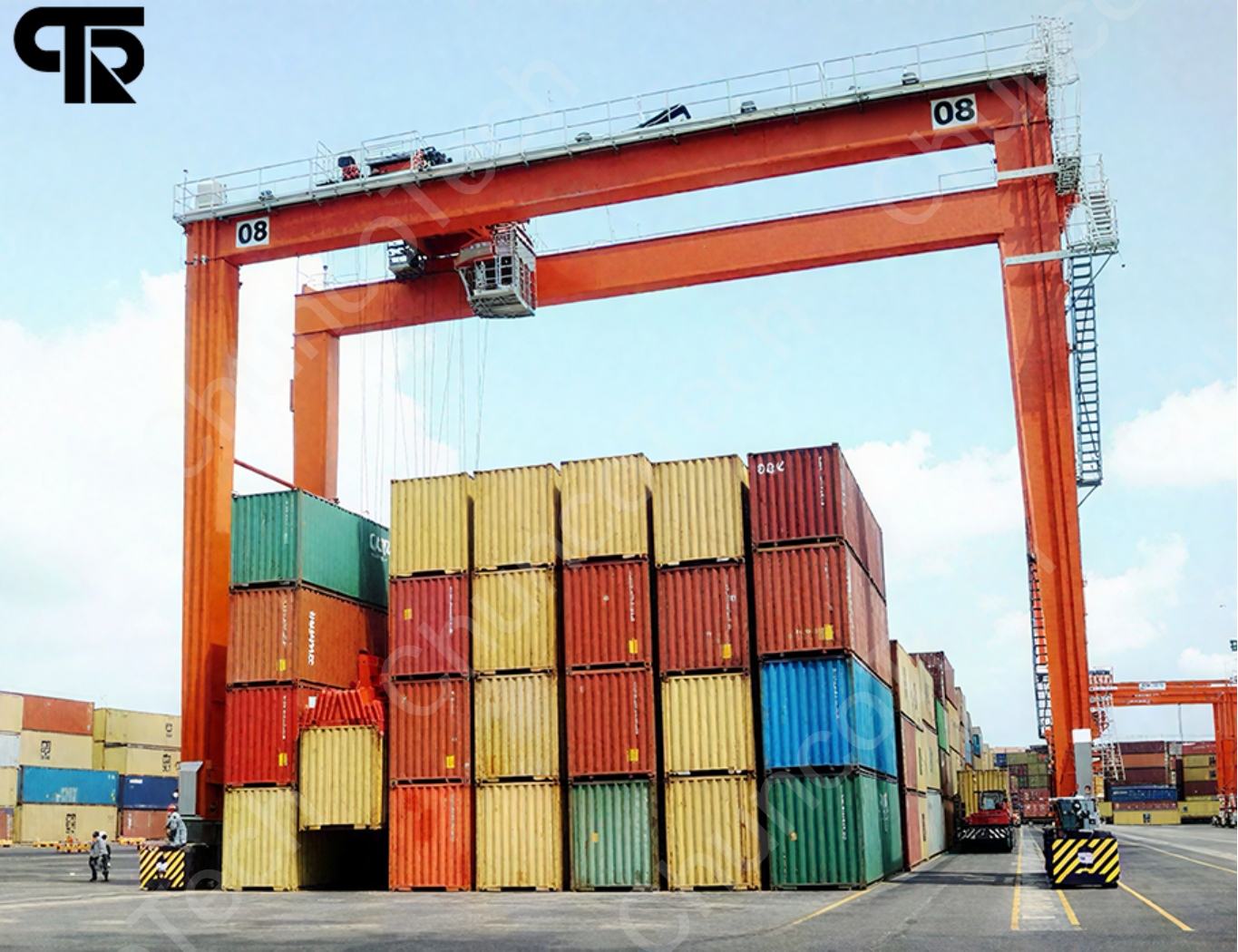
When a crane with a lifting capacity of several hundred tons relies entirely on rubber tires for support and movement, the torsional rigidity of the frame, the load limits of the tires, and the precision of multi-wheel coordinated steering become the critical factors determining success or failure. Wuxi ChuncoTech uses a heavy-duty box girder combined with balanced suspension in its chassis structure, ensuring that under heavy loads, the force on each tire is evenly distributed, avoiding tire blowouts or frame deformation caused by local overloads. At the same time, we select high-capacity solid rubber tires, completely eliminating the risk of punctures, allowing the equipment to operate calmly even on harsh ground conditions filled with steel bars and scattered gravel.
Solving the Three Major Problems: "Won't Move," "Won't Turn Smoothly," and "Won't Stop Steadily"
In actual use, operators of rubber-tired gantry cranes fear three situations most: first, the entire crane "squats" and won't move after lifting a heavy load; second, difficulty turning in narrow aisles, bumping into cargo; third, violent shaking during travel, causing the load to "swing like a pendulum." Wuxi ChuncoTech makes these problems history with three core technologies:
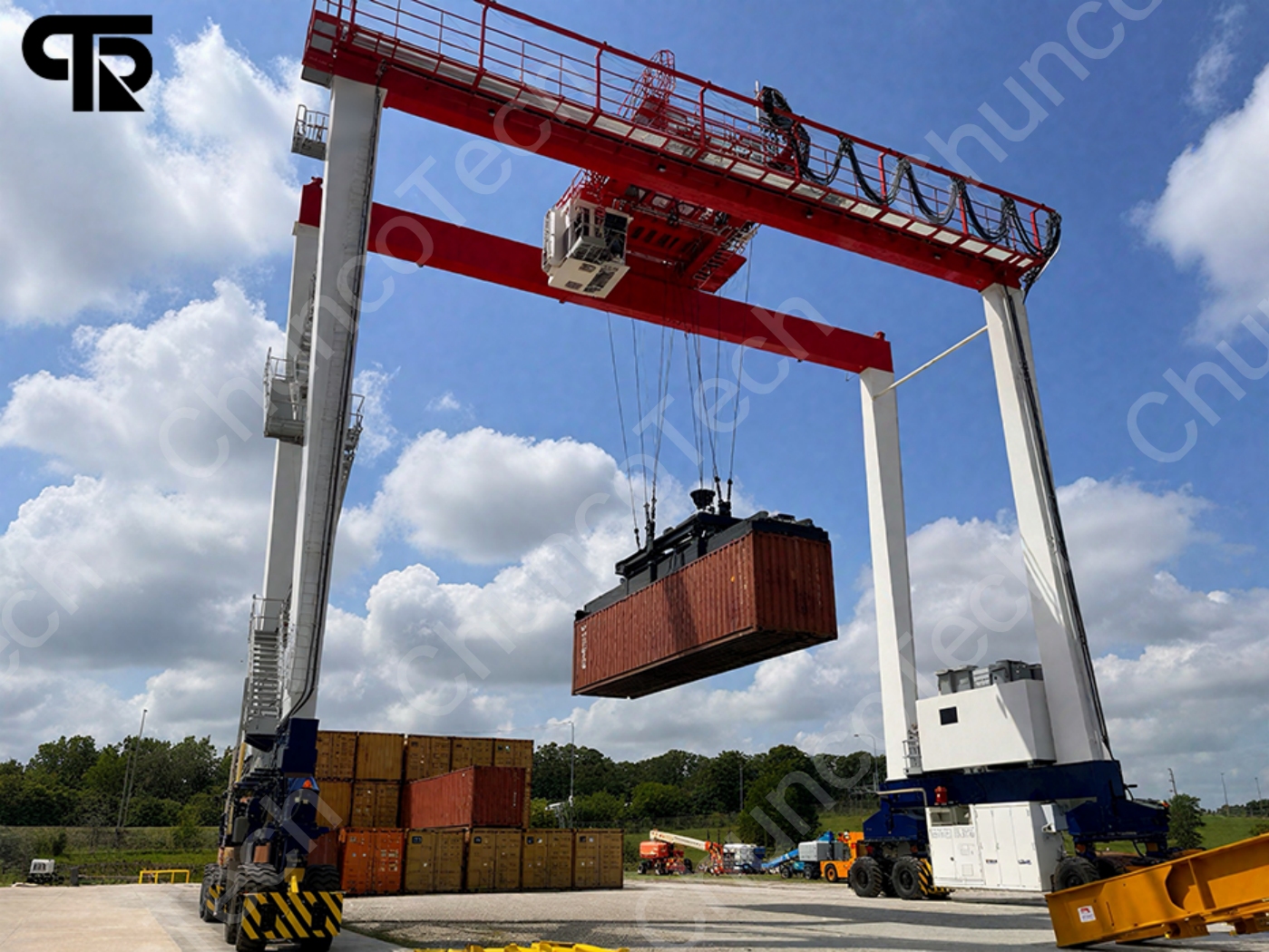
1.Independent Steering and Multi-Mode Travel Technology: Our equipment features independent hydraulic steering systems for each wheel group, supporting four travel modes: straight, diagonal, lateral, and spot turn. In narrow aisles of container yards, lateral mode allows the crane to transfer between container blocks without turning around. When precise positioning is needed, spot turn mode enables a 360-degree turn within the crane's own length – truly capable of "turning around in a snail shell."
2.Heavy-Load Travel and Power Distribution Technology: A self-weight of several hundred tons plus the cargo load poses a huge challenge to the travel drive system. Wuxi ChuncoTech uses multi-motor independent drive and intelligent torque distribution control, automatically adjusting drive force based on real-time adhesion of each tire to prevent slipping and veering. Even on wet surfaces or soft ground, the crane maintains smooth starts, uniform travel, and precise braking.
3.Load Anti-Sway and Rapid Positioning Technology: The rubber tires of an RTG have inherent elasticity, which can amplify the swing of the suspended load. We equip our cranes with an electronic anti-sway system and load attitude monitoring sensors, which calculate the swing angle in real time during travel and slewing and actively apply counter-control, keeping the load swing amplitude within centimeters, significantly reducing waiting time before lowering the hook.
From Storage Yards to Construction Sites: The All-Round Performer in the Rail-Free Era
Wuxi ChuncoTech's rubber-tired gantry cranes are widely used in container yards, railway freight yards, precast component plants, steel structure production bases, wind power equipment storage yards, and large-scale remote construction sites. Compared to the portal slewing cranes introduced in the previous article (which are fixed next to rails), the rubber-tired gantry crane has rail-free travel and multi-mode steering as its core advantages, expanding the "points" and "lines" of lifting operations into true "areas." When the portal slewing crane handles the dock shoreline, the giant gantry crane handles the dry-dock rails, and the RTG handles the entire storage yard and factory area, Wuxi ChuncoTech builds a complete capability network covering all lifting scenarios for its customers.
Choosing Wuxi ChuncoTech means you receive not just a rubber-tired gantry crane, but a mature solution validated by mass production. We have no uncertainty from R&D trial-and-error; all our products are mature models already in volume production with highly reliable performance. Whether you need container-handling RTGs for your yard or large-tonnage rubber-tired gantry cranes for your precast plant, please visit our website at https://www.chuncotech.com/ to obtain a professional solution for rail-free heavy-load lifting.