
Following our previous article, "Stiff Boom Cranes Use Lattice Booms to Achieve Heavy Load at Long Radius, Becoming the 'Never-Sag' Hardcore Lifting Tool for Extreme Conditions," we have already seen how stiff boom cranes, with their high lattice boom rigidity and long-radius lifting capacity, conquer heavy-load tasks at wind farms, bridge construction sites, and other extreme conditions where other equipment "can reach but cannot lift." However, when we turn our perspective to the core node of global trade – container terminals – a question critical to both efficiency and throughput becomes paramount: Hundreds of millions of containers – how are they unloaded from vessels to the dock and loaded from the dock onto vessels in the shortest possible time? A single day of vessel demurrage costs tens of thousands; low quayside crane efficiency chokes the entire supply chain.
The STS crane is the ultimate solution to this "container handling bottleneck." Specifically designed for ship-to-shore operations, it has ultra-large outreach, ultra-high lift height, and extremely short cycle time as its core capabilities, making it the "quayside backbone" of container terminals worldwide. However, many STS cranes on the market suffer from chronic issues such as "slow trolley travel speed, sluggish hoist mechanism response, difficult container alignment, and high electrical control system failure rates," turning what should be "smooth and flowing" handling operations into a "stop-and-go" struggle. Wuxi ChuncoTech's answer is: A true "quayside backbone" is not "how impressive the specifications look on paper," but rather "how many containers it can unload per hour, how low the energy consumption is per container, and how high the equipment availability is."
The Steel Giant Arm Reaching Across the Ship's Rail
An STS crane (full name: Ship-to-Shore Container Gantry Crane), also known as a quayside container crane or container handling bridge, consists primarily of a portal frame, main girder, front boom, rear boom, trolley, hoist mechanism, travel mechanism, and electrical control system. Unlike ordinary gantry cranes, the most distinctive feature of an STS crane is its front boom – a giant arm that extends forward, reaching across the quayside and projecting directly over the ship's rail, allowing the trolley to transport containers directly from the vessel to the area under the portal frame. The front boom is typically designed to be luffable, allowing it to be raised upward to clear the way for vessels during berthing, unberthing, or when a typhoon approaches.
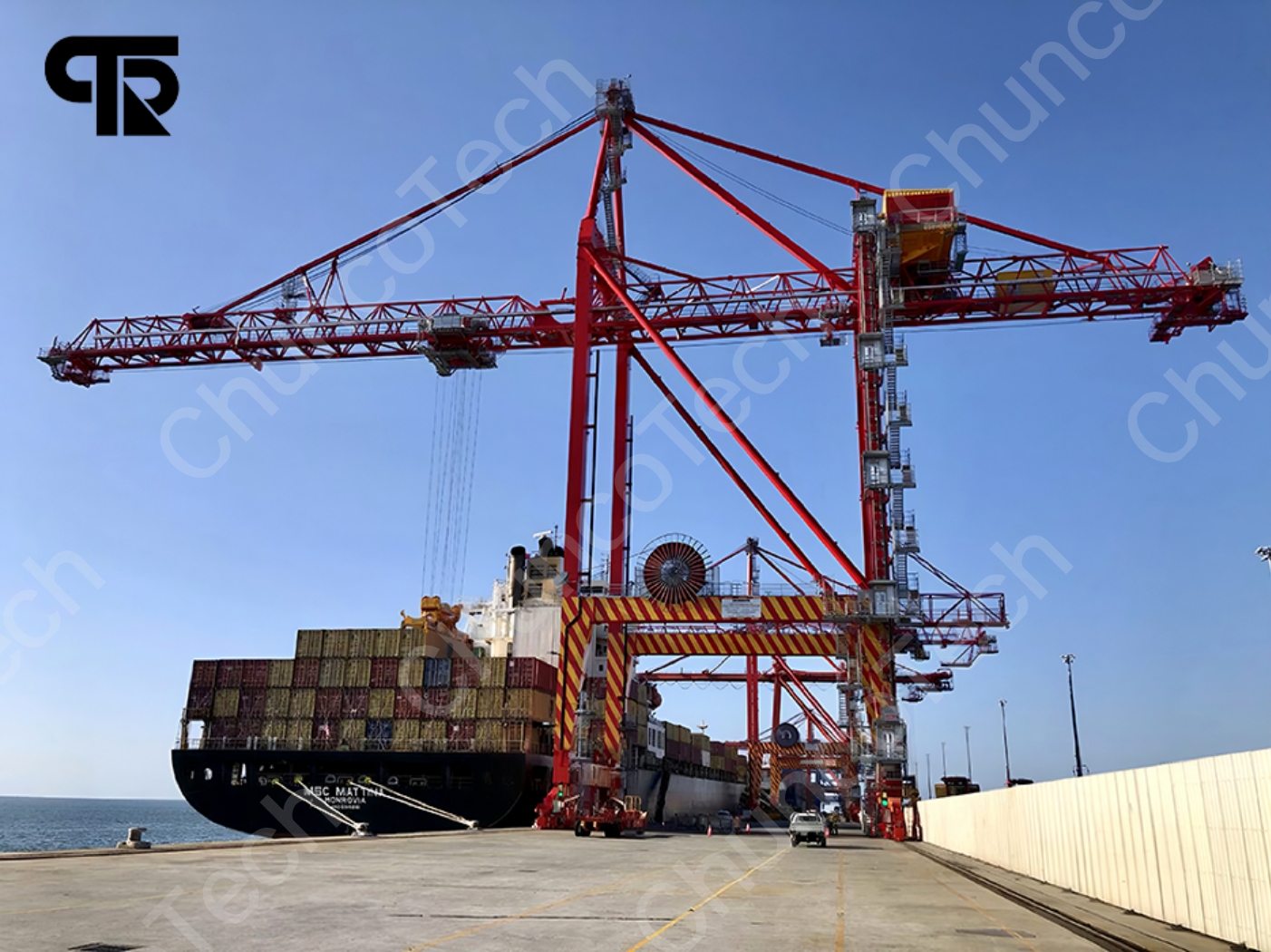
The core value of an STS crane lies in this: It is not designed for "yard operations" or "general lifting," but rather for "high-speed container transfer between ship and shore." A typical large STS crane has an outreach of 40 to 65 meters, sufficient to cover today's largest 24,000 TEU ultra-large container vessels. The lifting height can exceed 40 meters above rail, the hoisting speed can reach 90 meters per minute, and the trolley travel speed can reach 240 meters per minute. This means that a single STS crane can complete 35 to 45 or more container handling cycles per hour. In the design and manufacturing of STS cranes, Wuxi ChuncoTech takes high-speed hoist-trolley coordination, precise spreader-to-container alignment, electrical control system reliability, and overall wind stability as its four core technical areas.
Solving the Three "Efficiency Killers"
In container terminal loading and unloading operations, operators and terminal managers are most frustrated by three things: excessive acceleration and deceleration times for the trolley and hoist, lengthening cycle times; difficulty aligning the spreader with containers, especially when they are stacked multiple layers high in the hold or on deck; and high equipment failure rates, particularly in the electrical control system, where downtime causes enormous losses.
1.High-Speed Hoisting and Trolley Coordination: Single-cycle time is the core indicator of STS crane efficiency. We use high-performance variable frequency drive systems, with the hoist mechanism powered by dual or quad electric motors, achieving hoisting speeds of over 90 meters per minute and trolley travel speeds of over 240 meters per minute. Through intelligent speed curve optimization, we ensure smooth acceleration and deceleration without shock while maintaining high-speed operation, with spreader swing amplitude minimized. The coordinated coordination of hoisting and trolley travel allows operators to hoist or lower while the trolley is moving – time overlap, efficiency multiplied.
2.Precise Spreader Alignment and Anti-Sway Technology: Alignment time accounts for a significant portion of the single-cycle time. We equip our cranes with an electronic anti-sway system that controls spreader swing amplitude within ±30 millimeters. The spreader guide devices and twistlock automatic detection system, combined with camera-assisted alignment, allow operators in the cab to clearly see the alignment between twistlocks and container corner castings. An optional semi-automatic or fully automatic alignment system is available, using laser scanning or vision recognition to automatically complete alignment, significantly reducing operator fatigue.
3.Electrical Control System Reliability and Remote Diagnostics: The electrical control system of an STS crane is the "brain" of the entire machine, and its reliability directly determines terminal operational efficiency. We use redundant PLC configurations, with critical signals subject to multi-channel acquisition and redundant verification. A remote monitoring and fault diagnosis system monitors the operating status of each mechanism in real time, providing early warning of potential faults. Maintenance personnel can view equipment operating data through a remote interface and even perform preventive maintenance before faults occur, raising equipment availability to over 98%.
From Ultra-Large Vessels to Feeder Vessels: The "Full Vessel Type" Coverage of STS Cranes
Wuxi ChuncoTech's STS cranes are widely used at ultra-large container terminals, hub ports, feeder ports, and inland river container terminals. By outreach and lifting height, they can be classified as post-Panamax and standard types. By trolley configuration, they can be classified as single-trolley and twin-trolley types. Compared to the RMG cranes introduced in the sixth article (used for yard operations), the STS crane has ultra-large outreach, high-speed hoisting and trolley travel, and precise container alignment as its core advantages. Together, they form the complete "ship-to-shore, shore-to-yard" operational chain for container terminals. When STS cranes handle "ship-to-shore handling" and RMG cranes handle "yard stacking," Wuxi ChuncoTech builds for its customers an efficient container logistics equipment system ranging from vessel to dock, from dock to yard.

Choosing Wuxi ChuncoTech means you receive not just an STS crane, but a mature solution validated by multiple large container terminal projects. All our products are mature models already in volume production with highly reliable electrical and mechanical systems. Whether you need ultra-large STS cranes for a new deep-water container terminal or an STS upgrade and retrofit for an existing terminal, please visit our website at https://www.chuncotech.com/ to obtain a professional solution for efficient quayside container handling.