
Following our previous article, "Floating Dock Cranes Use Floating Platform Adaptability to Become the 'Ocean-Pacifying Anchor' for Ship Repair and Offshore Construction," we have already seen how specialized cranes on floating dock platforms overcome tilting, swaying, and salt spray corrosion to perform precise lifts in ship repair and offshore construction. However, when we shift our focus from "floating platforms" back to "onshore extreme manufacturing" – ship sections hundreds of meters long in shipyards, integrated modules weighing tens of thousands of tons for offshore engineering platforms, steel containment vessels tens of meters in diameter for nuclear power plants, and rotors and stators weighing hundreds of tons for large hydropower stations – an even more fundamental question emerges: what is needed here is not "overcoming platform sway," but rather "moving ultra-heavy objects with ultra-high precision over ultra-large spans."
The giant gantry crane (also known as a goliath crane or ultra-large portal crane) is the ultimate answer to this world-class challenge. It spans over a hundred meters across dry docks or assembly yards, lifts thousands or even tens of thousands of tons, and transforms "impossible tasks" into routine flow-line operations. However, the challenges of ultra-large-tonnage gantry cranes on the market remain acute: some have overly heavy structures leading to astonishing energy consumption, some exhibit unacceptable elastic deformation under extreme loads, and some suffer from multi-point coordination where each lifting point "works independently," causing component distortion or even damage. Wuxi ChuncoTech's answer is: A true "sky-supporting pillar" is not just "being able to lift," but rather "maintaining millimeter-level precision and rock-solid stability under extreme tonnage and extreme span."
The Steel Backbone That Spans Limits
A giant gantry crane – in industry terms, typically refers to a large portal crane with a lifting capacity exceeding several hundred tons and a span exceeding several tens of meters. In the truly "giant" category, lifting capacities can reach thousands or even tens of thousands of tons, and spans can exceed 150 meters. Its structure consists of a main girder, legs, end beams, trolley(s), and travel mechanisms, forming a massive "door" shape. The main girder is the core load-bearing component, the full weight of the lifted load; the legs transfer the load to the ground rails; the trolley(s) travel along the main girder, enabling horizontal movement and precise positioning of heavy loads; the travel mechanisms move the entire crane longitudinally along the dry dock.
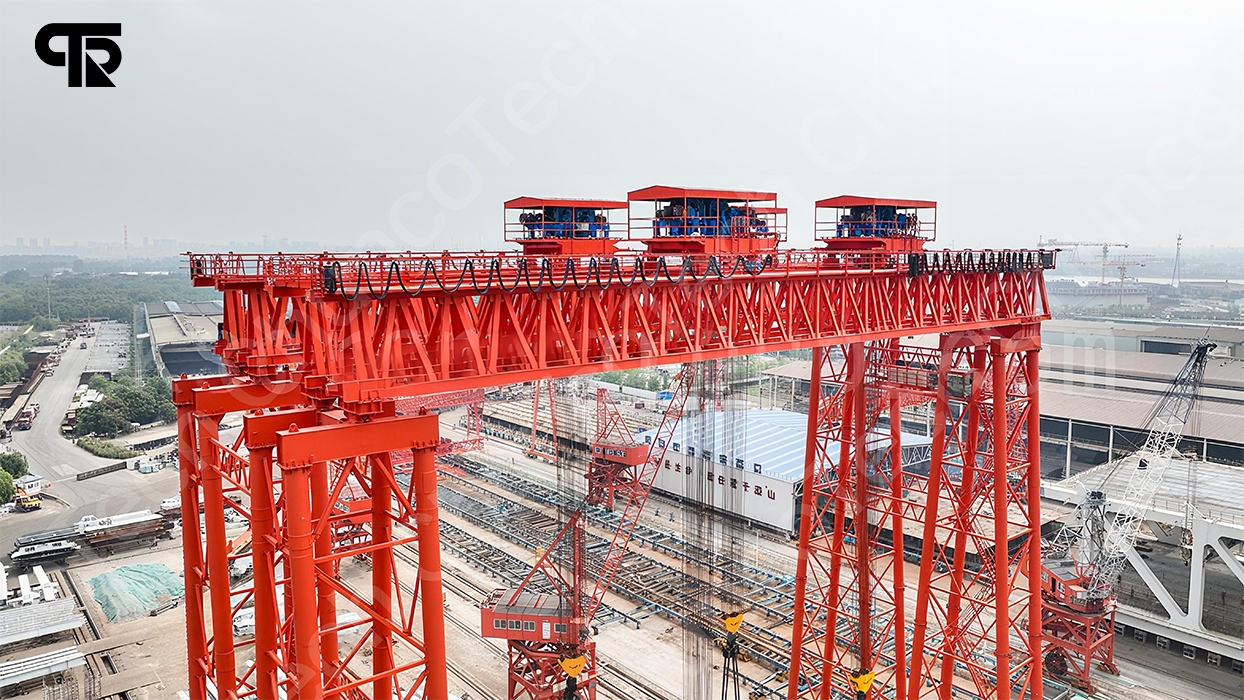
The core value of a giant gantry crane lies in this: It is not designed for "general handling," but rather for "moving ultra-heavy objects with ultra-high precision over ultra-large spans." A 22,000-ton giant gantry crane, in a single lift, can move a weight equivalent to more than twenty thousand passenger cars. Operations at this magnitude demand levels of structural rigidity, strength, stability, as well as travel mechanism synchronization and reliability, that are unattainable by ordinary cranes. In the design and manufacturing of giant gantry cranes, Wuxi ChuncoTech integrates finite element analysis and topology optimization, high-strength steel and pre-stressed camber, and multiple levels of safety redundancy and intelligent monitoring throughout the entire process.
Solving the Three "Extreme Challenges"
In ultra-large-tonnage lifting operations, project managers and operators worry most about three things: excessive deflection of the main girder under heavy loads causing horizontal deviation of the load beyond tolerance; coordination mismatch among multiple trolleys or multiple lifting points causing uneven force distribution or even distortion of the component; and asynchronous travel of the two sides causing rail gnawing, jamming, or even structural damage.
1.Ultra-High Rigidity Main Girder and Anti-Deformation Design: We adopt truss-type or large-section box girder structures and achieve lightweighting through finite element topology optimization – reducing weight by 15% to 25% compared to conventional designs while maintaining rigidity. Key load-bearing areas of the main girder use high-strength low-alloy steel, and we implement pre-stressed camber during manufacturing to precisely offset elastic deformation under heavy loads. In 125% rated load static load testing, the end deflection of our main girder is far superior to international standards, ensuring that the lifted load remains level at mid-span.
2.Multi-Point Coordination and Intelligent Load Equalization: Giant components often require two, four, or even eight lifting points to operate simultaneously. We equip our cranes with an intelligent load equalization system that uses high-precision sensors to monitor the actual load at each lifting point in real time, with a PLC automatically calculating and adjusting the hoisting height and speed of each trolley, ensuring that the force deviation at each lifting point is controlled within ±5%. No matter how the component's center of gravity shifts, the system "automatically levels" itself – the load can be safely lifted off the ground in one attempt.
3.Travel Synchronization and Anti-Rail-Gnawing Technology: We employ a multi-positioning fusion solution combining laser distance measurement + rotary encoders + gray code strips to achieve real-time comparison and closed-loop control of the travel positions of both sides, with synchronization error controlled within ±5 millimeters. The wheels feature double-flange design paired with an automatic centralized lubrication system. Key drive components use redundant configuration – even if a single drive unit fails, the entire crane can still move at low speed to a safe location.
From Shipbuilding to Nuclear Power: The "National Heavy Equipment" of Extreme Lifting
Wuxi ChuncoTech's giant gantry cranes are widely used in ultra-large ship section and superblock lifting, onshore fabrication and launching of offshore oil platforms, large structural module lifting for nuclear island buildings, ultra-large hydropower station unit installation, and integral erection of large bridge steel towers and steel girders – major national-level engineering projects. Compared to floating dock cranes, the giant gantry crane has ultra-large span, ultra-high lifting capacity, multi-point coordination, and intelligent load equalization as its core advantages. While other cranes handle "daily handling," giant gantry cranes are responsible for "the birth of national heavy equipment and the execution of super-engineering projects."
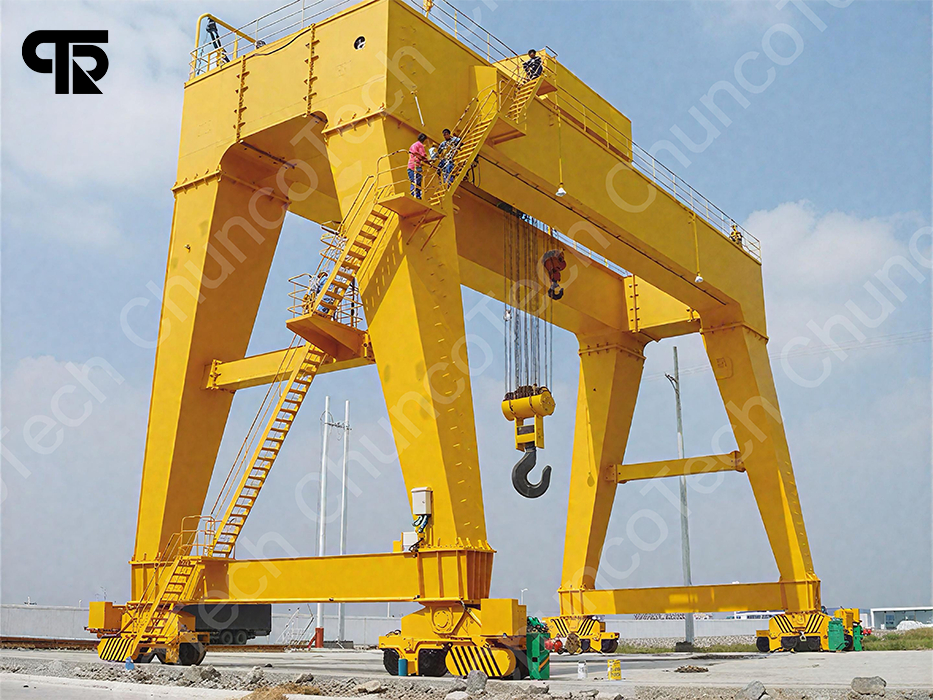
Choosing Wuxi ChuncoTech means you receive not just a giant gantry crane, but a mature solution validated by multiple major national-level projects. All our products are mature models already in volume production with highly refined technology and manufacturing processes. Whether you are expanding an ultra-large shipbuilding dry dock or building a new-generation nuclear power base, please visit our website at https://www.chuncotech.com/ to obtain a professional solution for extreme-tonnage, extreme-span, extreme-precision lifting.