
Following our previous article, "STS Cranes Use Ultra-High Efficiency and Precise Container Alignment to Become the 'Quayside Workhorse' for Container Terminal Loading and Unloading," we have already seen how STS cranes, with their front booms reaching over the ship's rail and their ability to complete dozens of cycles per minute, transfer containers from vessels to the dock. However, once the cargo is exchanged between ship and shore, the next question follows immediately: How are containers unloaded from the quayside quickly and orderly transferred to the rear yard? How can more containers be stacked within a limited yard area? How can a specific container be retrieved efficiently and accurately when needed?
The RTG crane is precisely the core answer to this "yard operation" challenge. With its rubber tyres enabling rail-free travel and its multi-mode steering allowing flexible movement through container yards, it dramatically improves yard utilization with stacking capabilities of "stack five, pass six" or even higher tiers. However, many RTGs on the market suffer from chronic issues such as "travel slippage, difficult steering, inaccurate spreader positioning, and excessive energy consumption," turning what should be flexible yard operations into clumsy and inefficient struggles. Wuxi ChuncoTech's answer is: A true "mobile workhorse" is not "just being able to move," but rather "moving freely and confidently under heavy loads while remaining precise and stable in every stacking operation."
The Yard Giant on Tyres
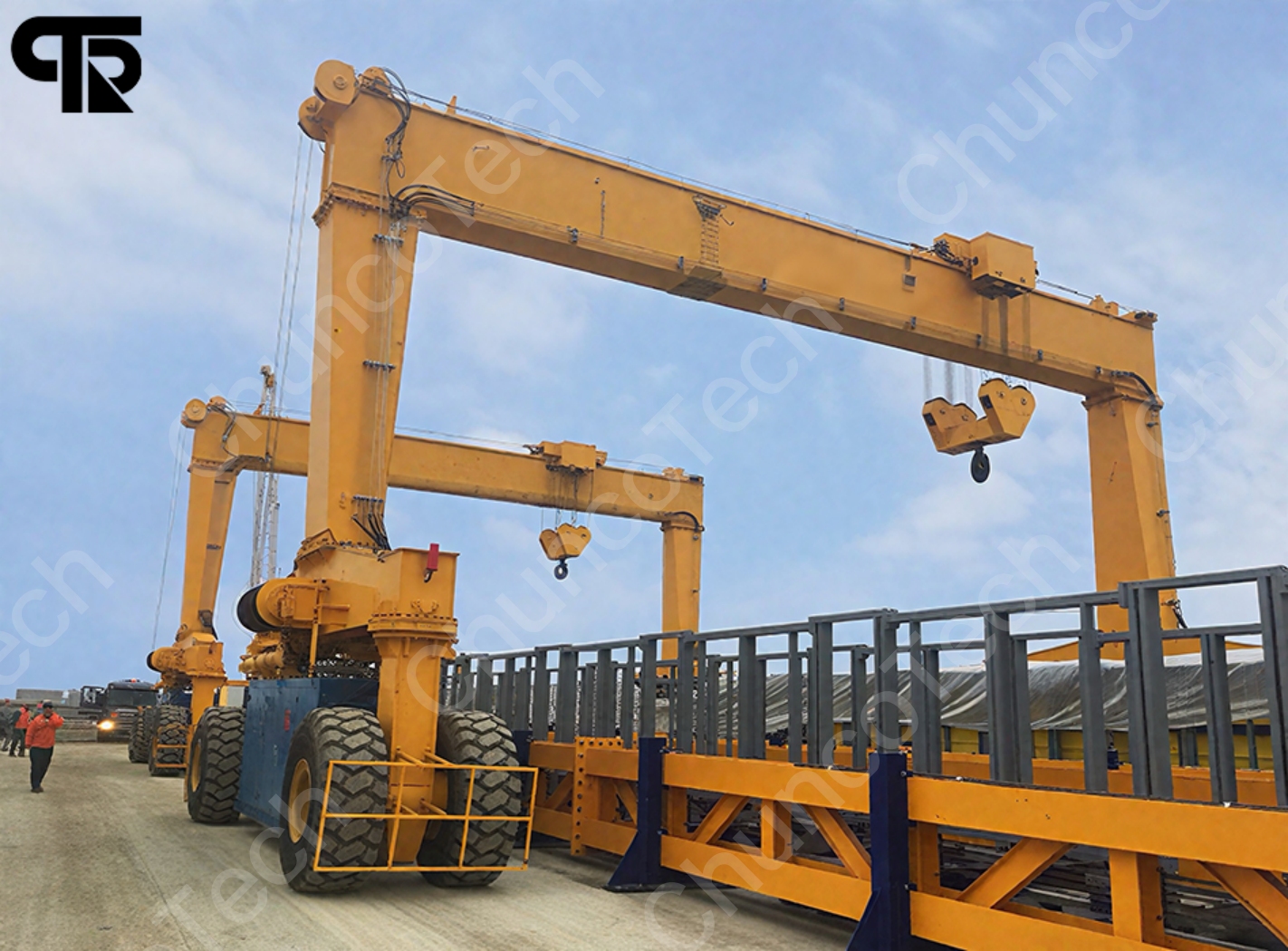
An RTG crane, also known as a rubber-tyred gantry crane or yard crane, shares a similar structure with giant gantry cranes – consisting of a main girder, legs, end beams, and trolley – but the biggest difference is: instead of steel wheels and rails, multiple sets of solid rubber tyres and independent steering mechanisms are installed at the bottom of its legs. This change frees the RTG from the constraints of rails, allowing it to relocate freely within the yard and adjust its position at any time based on operational needs.

The core value of an RTG crane lies in this: It is not designed for "ship-to-shore handling," but rather for "efficient yard stacking and transfer." A typical RTG has a lifting capacity of 40 to 50 tons, a span that can cover six rows of containers plus one lane, and a stacking height of 5 to 6 tiers – with some models even achieving 7-tier stacking. Through the coordinated action of gantry travel, trolley cross-travel, and spreader hoisting, the RTG can reach every container position within its operating zone. In the design and manufacturing of RTG cranes, Wuxi ChuncoTech takes heavy-load travel drive, multi-mode steering, spreader anti-sway and positioning, and energy saving as its four core technical areas.
Solving the Three "Operational Difficulties"
Operators and yard managers are most frustrated by three things: tyre slippage under heavy loads, making travel and steering difficult; excessive spreader swing during high-speed travel and high-tier stacking, causing lengthy alignment times; and high energy consumption, putting pressure on operating costs.
1.Heavy-Load Travel and Anti-Slip Control: We use multi-motor independent drive and intelligent torque distribution control, automatically adjusting drive force based on each tyre's real-time adhesion to prevent slipping and veering. The tyres are high-capacity solid rubber tyres, completely eliminating the risk of punctures. Differential locks and anti-slip control systems ensure that even in rainy or snowy weather or on wet surfaces, the RTG maintains smooth starts, uniform travel, and precise braking.
2.Spreader Anti-Sway and Precise Stacking: We equip our cranes with an electronic anti-sway system that, through variable frequency speed control and speed curve optimization, controls spreader swing amplitude within ±25 millimeters. Laser or camera-assisted alignment systems display the relative position between the spreader and container corner castings in real time. An optional semi-automatic stacking system is available – the operator simply confirms with one button, and the system automatically completes the entire sequence of lowering, alignment, landing, and twistlock release.
3.Energy Saving and Power Option Selection: We offer multiple power solutions – diesel engine-generator set (flexible but high fuel consumption), diesel-battery hybrid (30% to 40% fuel consumption reduction), and lithium battery electric drive (zero emissions, low noise, with quick battery swap capability). Customers can select the optimal solution based on their operational intensity and environmental requirements.
From Container Yards to Rail Terminals: Full-Scene Coverage of RTGs
Wuxi ChuncoTech's RTG cranes are widely used at seaport container yards, inland river port yards, rail container centers, and highway freight hub yards. Compared to rail-mounted RMG cranes, the RTG has rail-free travel, multi-mode steering, and flexible relocation as its core advantages. When STS cranes handle "ship-to-shore handling," RMG cranes handle "rail-mounted automated stacking," and RTG cranes handle "flexible mobile yard operations," Wuxi ChuncoTech builds for its customers a complete container logistics equipment system ranging from ship to shore, from shore to yard, from rails to tyres.
Choosing Wuxi ChuncoTech means you receive not just an RTG crane, but a mature solution validated by multiple large yard projects. All our products are mature models already in volume production with highly reliable drive and steering systems. Please visit our website at https://www.chuncotech.com/ to obtain a professional solution for flexible and efficient container yard operations.