
Following our previous article, "Straight Boom Cranes Use Telescopic Booms to Achieve Long Reach and High Lift, Becoming the 'Long-Arm Experts' for Precision Lifting in Open Spaces," we have already seen how straight boom cranes, with their telescopic booms, deliver hooks to distances and heights of tens of meters in open scenarios such as ports, docks, and construction sites. However, when operational requirements upgrade from "general long distance" to "heavy load at long radius" – lifting heavy equipment to the deepest parts of ship holds at quaysides, delivering large steel beams to column tops in steel structure installation, placing formwork to the outer sides of bridge piers in bridge construction, lifting spare parts to engine rooms tens of meters high in wind farm maintenance – the question is no longer "can it reach," but rather "after reaching that far, can the boom still 'hold up,' and how much lifting capacity remains."
When a conventional telescopic boom crane is fully extended, its lifting capacity often attenuates to a fraction of its rated value – or even less – leaving operators in the awkward situation of "I can reach it, but I can't lift it." The stiff boom crane (also known as a lattice boom crane or fixed-length boom crane) is designed precisely to solve this dilemma. It uses a lattice-type stiff boom, sacrificing telescoping convenience in exchange for "anti-attenuation" lifting capacity performance at long radius. Wuxi ChuncoTech's answer is: True "hardcore" performance is not "being so stiff that it never bends," but rather "at the radius where others 'sag,' you can still lift with your head held high."
Stiffness Is the Confidence for Heavy Load at Long Radius
A stiff boom crane is most notably characterized by a non-telescopic lattice structure boom, with the working radius and lifting height adjusted by changing the angle between the boom and the horizontal plane through luffing cylinders. Unlike the "telescoping" of straight boom cranes, the boom length of a stiff boom crane is fixed. This design sacrifices transport and stowage convenience but exchanges it for higher bending rigidity per unit self-weight and superior long-distance lifting capacity. At maximum working radius, the lifting capacity of a stiff boom crane can be two or even three times that of a comparable telescopic boom crane.
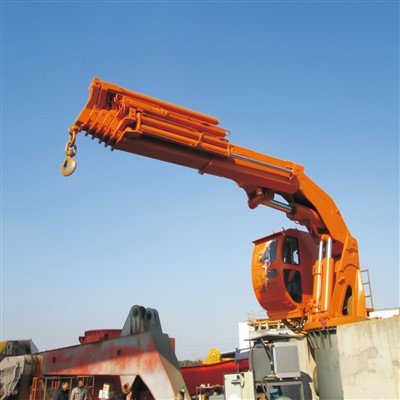
The core value of a stiff boom crane lies in this: It is not designed for "rapid relocation" or "tight spaces," but rather for "maintaining respectable lifting capacity at maximum radius." At extreme positions – deep inside ship holds, outside bridge piers, atop engine rooms – a stiff boom crane can calmly complete tasks that other equipment "can reach but cannot lift."
Solving the Three "Extreme Tests"
Operators worry most about three things: excessive boom self-weight causing high center of gravity and insufficient stability; jerky and unstable luffing motion; and excessive lateral swing of the lattice boom under side wind loads.
1.Lattice Boom Lightweighting and High Stiffness: Using high-strength steel tubes (Q460, Q690 grades) to manufacture lattice booms, with finite element topology optimization determining optimal node layouts, achieving over 30% reduction in boom self-weight while maintaining or even improving rigidity. Key nodes use cast steel nodes or reinforcing plates, ensuring no cracking after millions of fatigue cycles.
2.Luffing Smoothness and Precision Control: Using dual control of proportional flow valves + luffing balance valves, paired with a load-sensing hydraulic system, to achieve stepless speed control and smooth operation throughout – whether empty or fully loaded, at minimum or maximum angle – with no shock and no creeping.
3.Wind Stability and Anti-Lateral-Swing: Strict overturning stability checks are performed according to working wind class and survival wind class. An optional anti-lateral-swing control system is available, using active slewing correction and boom damping devices to control lateral swing within safe limits.
From Docks to Wind Farms: The "Hardcore" Battlefield of Stiff Booms
Wuxi ChuncoTech's stiff boom cranes are widely used in heavy equipment lifting deep inside ship holds at ports, formwork and rebar lifting on the outer sides of bridge piers, nacelle and blade maintenance lifting in wind farm operations, long-span beam and column delivery in steel structure installation, and "obstacle-crossing" lifting for large equipment. Compared to straight boom cranes, stiff boom cranes have lifting capacity retention at long radius, high rigidity of the lattice boom, and wind stability as their core advantages – the two complement each other: straight boom cranes handle "general long distance," while stiff boom cranes handle "extreme radius heavy loads."
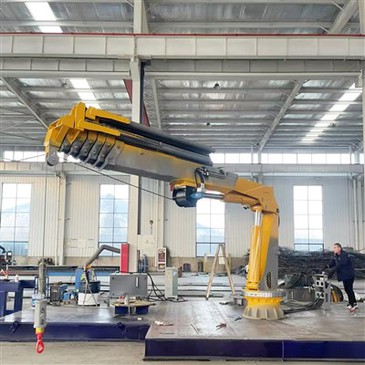
Choosing Wuxi ChuncoTech means you receive not just a stiff boom crane, but a mature solution validated by multiple major engineering projects. All our products are mature models already in volume production with highly reliable lattice structures and hydraulic systems. Please visit our website at https://www.chuncotech.com/ to obtain a professional solution for extreme-radius heavy-load lifting.