
In our last article, “How to Efficiently Handle Crane Flange Plate Warping?”, we tackled a critical technical challenge that directly impacts crane reliability. Today, we move from component-level fixes to a bigger question: which mainstream port crane type actually fits your operation, budget, and throughput goals—without eating into your margins?
Selecting the wrong crane leads to low container handling efficiency, high fuel and maintenance costs, yard congestion, and unnecessary capital lock-up. At Wuxi ChuncoTech, we don’t just sell cranes—we help port operators, terminal managers, and logistics hubs match the right machine to the right scenario. Below is a clear, no-marketing-fluff comparison of six major crane types, based on real-world port applications.
• Explore our full crane range: https://www.chuncotech.com/
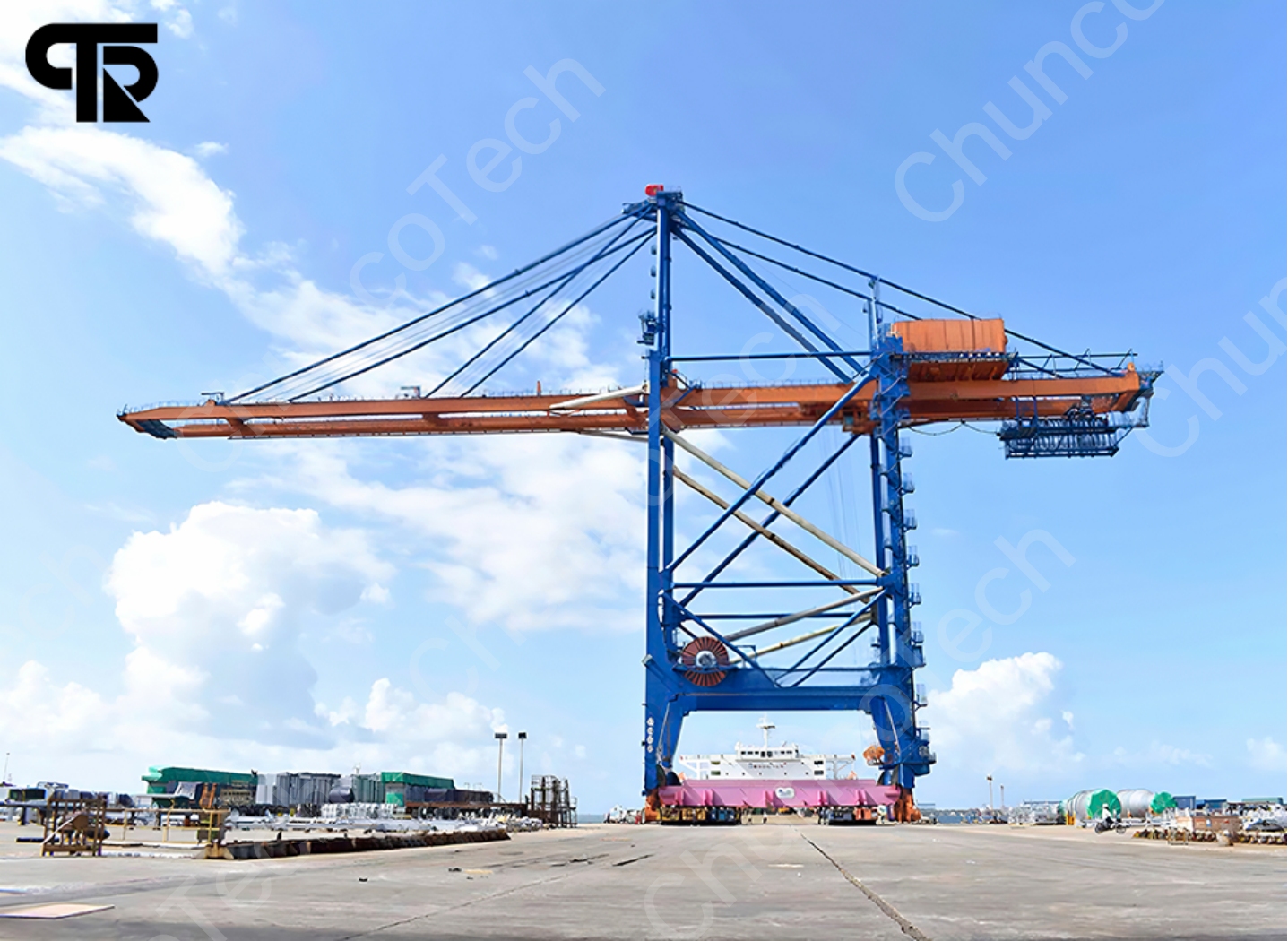
Ship-to-Shore Crane – The King of Berth Productivity
Best for: high-volume container terminals, deep-water hubs, ultra-large vessel handling.
STS cranes dominate frontline berth operations. Their high lifting capacity (40–80 tons) and extended outreach handle today’s largest box ships. Modern automated STS units achieve 35–50 moves per hour.
Why operators choose STS:
•Stable and weather-resistant – rail-mounted, low downtime.
•Automation-ready – remote control and positioning systems cut labor costs.
The trade-offs:
•High upfront cost – millions per unit.
•Zero mobility – fixed to the berth.
•Heavy infrastructure needed – reinforced quay and rails.
Wuxi ChuncoTech advantage: We supply cost-effective STS cranes with proven automation compatibility—ideal for terminals upgrading without overspending.
Portal Harbor Crane – The Flexible All-Rounder
Best for: breakbulk, general cargo, bulk ports, small to medium container terminals.
Portal harbor cranes (often called gantry cranes or goliath cranes) excel at multi-cargo handling. Swap hooks, grabs, or magnets to handle steel, coal, grain, or even odd containers.
Why port managers rely on them:
•Wide coverage – 360° rotation, reaches vessel and back-up yard.
•Moderate cost – lower than STS.
•Mobility options – rail or tire-mounted.
Limitations:
•Slow container cycles – only 8–12 boxes/hour.
•Tire-mounted units need weather caution.
Wuxi ChuncoTech tip: For mixed-cargo ports, a tire-mounted portal crane offers the best flexibility without major civil works.

Rail-Mounted Gantry Crane – Yard Density Champion
Best for: large, dedicated container yards with high stacking density.
RMGs run on fixed rails and stack 5–7 high. They are the most space-efficient yard crane. Electric drive keeps long-term operating costs low.
Strengths:
•High throughput – 20–30 boxes/hour.
•Fully automatable – unmanned stacking and truck loading.
Weak points:
•Zero redeployment – cannot move between rows.
•Rail and power investment – high initial civil cost.
•Sensitive to ground settlement.
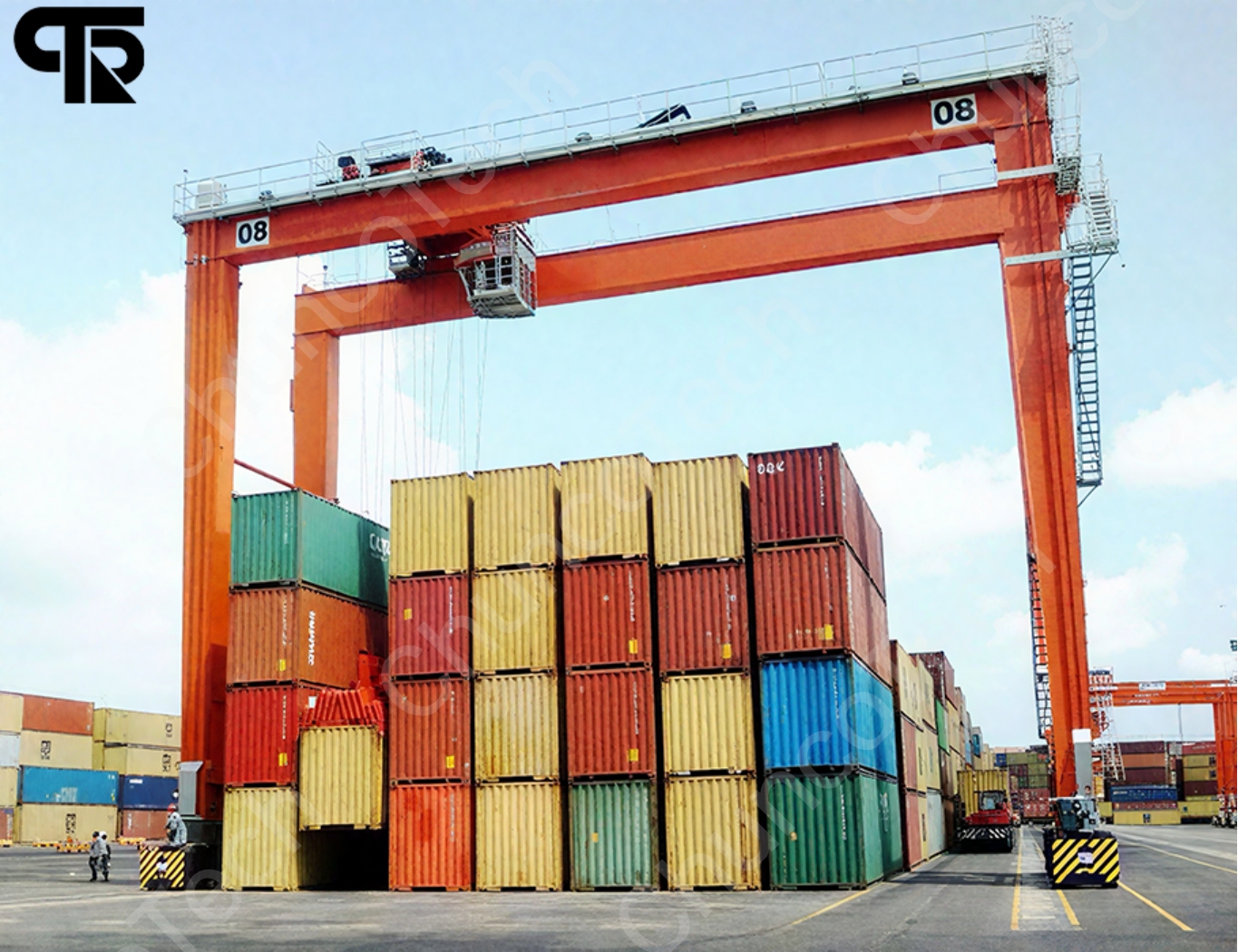
Rubber-Tired Gantry Crane – Yard Mobility Master
Best for: medium yards, temporary yards, multi-row shunting, feeder ports.
RTGs move freely across the yard without rails. They stack 4–6 high and offer 15–25 moves/hour.
Why users accept slightly lower density:
•No rail or power lines – lower civil cost.
•Relocatable – ideal for changing layouts.
Downsides:
•Higher fuel/maintenance cost (diesel or lithium battery options exist).
•Less wind-stable than RMG.
•Harder to automate due to tire positioning drift.
✅ Wuxi ChuncoTech RTGs are designed with simpler hydraulic and tire systems to reduce your daily operating expenses.
Reach Stacker – The Ultimate Yard Utility Tool
Best for: small ports, empty depots, logistics parks, emergency shunting, and multi-box-size handling.
Reach stackers are tire-mounted with telescopic booms. They grab containers directly from trucks, stack 2–4 high, and turn 360° in tight spaces.
Key benefits:
•No infrastructure needed – works on any hardstand.
•Handles 20’, 40’, 45’ boxes and even heavy out-of-gauge cargo.
•Low entry cost.
Real-world limits:
•Low productivity – only 5–10 boxes/hour.
•High operator skill needed – poor automation potential.
•High fuel and tire wear.
Empty Container Handler – The High-Density Specialist
Best for: empty container depots and dedicated empty yards.
This purpose-built machine stacks empties 6–12 high with fast lift speeds. It handles 15–20 empties/hour at very low cost per move.
Why depots love them:
•Low purchase price – roughly 1/3 to 1/2 of a reach stacker.
•Simple operation – minimal training.
•Small footprint – fits narrow aisles.
But only for empties:
•Cannot lift loaded containers – safety risk.
•No other cargo capability.
Wuxi ChuncoTech empty handlers are electric and diesel-ready – match your green goals without overpaying.
Smart Selection – No Single Crane Fits All
The right port crane choice is always a trade-off between specialization versus versatility, speed versus mobility, and first cost versus long-term operating cost.
For hub or deep-water container terminals, the recommended combination includes automated STS cranes at the berth, RMGs for high-density yard stacking, complemented by a few RTGs and reach stackers for flexible shunting, plus empty handlers for the empty depot.
For feeder ports or river ports, smaller STS cranes or portal harbor cranes work well at the berth, with RTGs and reach stackers handling yard operations, and empty handlers serving the empty container area.
For breakbulk or bulk ports, portal harbor cranes should be the main workforce, with a reach stacker added only if occasional container moves are needed.
For small terminals or logistics parks, reach stackers can serve as the primary container handler, supported by empty handlers for the empty yard—no large fixed cranes required.
For temporary or overflow yards, RTGs and reach stackers are the best choices because they need no civil works and can be relocated after the job ends.
Final Thought – Match the Crane to Your Real Workflow
No single crane does everything. The most profitable ports use a combination: dedicated equipment for high-volume tasks, and flexible units for the rest.
Wuxi ChuncoTech does not develop experimental machines. We supply proven, production-ready cranes that are already operating efficiently in ports worldwide. Whether you need a ship-to-shore crane, gantry crane, goliath crane, RMG, RTG, reach stacker, or empty container handler—we focus on reliable performance, lower total cost of ownership, and practical after-sales support.
•Contact Wuxi ChuncoTech today
Let’s match the right crane to your real port operation.
This article is part of our port equipment deep-dive series. Read the previous piece: “How to Efficiently Handle Crane Flange Plate Warping?” for more maintenance and reliability insights.