
In our previous discussion on “Is Your Bulk Material Unloading Still a Dusty, High-Maintenance Nightmare?”, when we focus on the core equipment of ports and terminals—the bridge-type grab ship unloader—many managers realize the hidden challenges behind seemingly efficient operations: environmental compliance issues, typhoon threats, and the real cost of maintenance.
In the field of bulk cargo handling such as coal and ore, the bridge-type grab ship unloader, as the main equipment model, directly impacts the operational efficiency of the entire terminal. According to the national standard GB/T 26475-2021 "Bridge-Type Grab Ship Unloader", this equipment is primarily designed for handling operations with rated unloading capacities ranging from 400t/h to 5000t/h. However, in practical working conditions, many users face challenges far beyond just the productivity indicator.
Environmental Pressure: The Technological Leap from "Water Spray" to "Dry Fog Dust Suppression"
Traditional ship unloader operations often involve troublesome dust issues. When the grab opens for discharge, when materials fall into the hopper, and when the feeding belt conveyor operates, dust spreads everywhere—not only polluting the environment but also threatening the health of operators and nearby residents.
According to current national standards, the dust concentration at the grab discharge point must be controlled to ≤100mg/m³, and at various transfer points, it must be ≤50mg/m³. Relying solely on traditional water spray systems often makes it difficult to consistently meet these standards, and there is also the risk of icing during winter operations. The current solution has evolved to dry fog dust suppression systems: using an air compressor to generate high-pressure air, which mixes with water to produce micron-sized fog particles that effectively adsorb suspended dust particles in the air. Practical application cases show that this two-fluid dry fog suppression technology not only achieves dust suppression rates of over 90% but also uses only 10% of the water required by traditional spray systems. It perfectly addresses the environmental challenges during coal and ore handling, while also avoiding hopper clogging caused by excessive material moisture content.
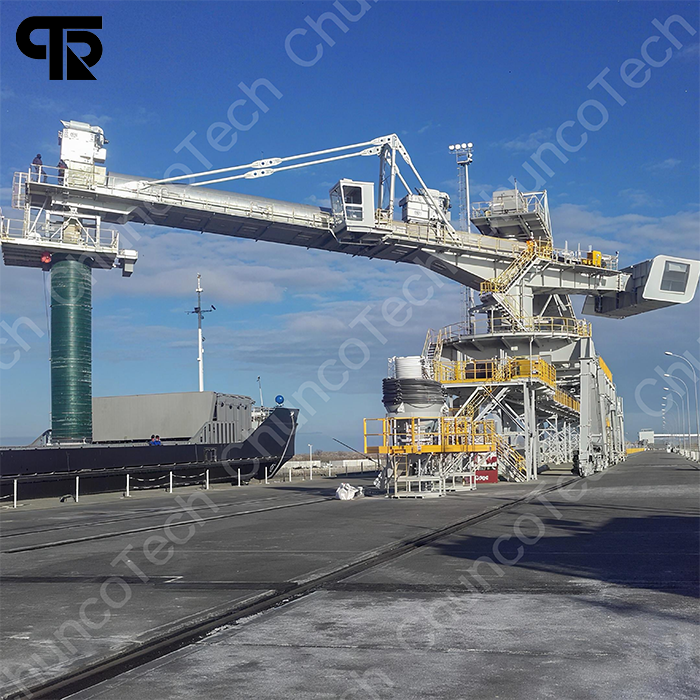
Wind and Typhoon Resistance: The Lifeline for Port Equipment
For coastal ports, the wind and typhoon resistance capability of bridge-type grab ship unloaders is a critical factor in design. The standard clearly specifies that the working condition wind speed should not exceed 20m/s (equivalent to Beaufort scale 6), while the non-working condition must withstand extreme wind speeds of up to 49m/s (equivalent to Beaufort scale 12).
Every year during typhoon season, we see news of port equipment damage due to inadequate typhoon prevention measures. A comprehensive typhoon response plan involves far more than simple anchoring. It includes a series of standardized operations: moving the gantry to the designated anchor position and locking it, tensioning the typhoon tie-downs, locking the rail clamps (or wheel clamps, rail top brakes), inserting rail wedges, placing the grab open and secured on the hopper grating, moving the operator cabin to the parking position and locking it, and lowering the boom to the designed wind-resistant position. Wuxi ChuncoTech deeply understands this challenge. In our ship unloader design solutions, we strengthen the typhoon resistance system as a core safety module, ensuring the equipment remains secure under extreme weather conditions.

Maintenance Costs: From "Manual Inspection" to "Intelligent Centralized Lubrication" for Cost Reduction and Efficiency Increase
A bridge-type grab ship unloader has hundreds of lubrication points across its gantry travel mechanism, trolley traction mechanism, hoisting and closing mechanism, luffing mechanism, and more. The traditional manual lubrication mode requires maintenance personnel to work at heights—not only inefficient and unsafe, but the lubrication effect depends entirely on the operator's responsibility and skill level. An even more challenging issue is that manual lubrication cannot be performed while the equipment is running, often leading to equipment being operated until problems arise, ultimately resulting in mechanical failures due to poor lubrication—statistics show that over 60% of mechanical failures in ship unloaders stem from inadequate lubrication.
Addressing this long-standing challenge, intelligent centralized lubrication systems have emerged. The system adopts a distributed architecture, dividing the entire machine into independent lubrication zones such as the gantry travel mechanism, girder tower, and main trolley. Remote monitoring is achieved through industrial control tablets and 485 bus communication. The system supports Auto mode, Manual mode, and Maintenance mode: in Auto mode, the lubrication system operates synchronously with equipment operation, injecting grease at scheduled intervals and quantities to each lubrication point while monitoring distributor working status and oil circuit pressure in real-time; if blockage or abnormality occurs, an immediate audible and visual alarm is triggered in the operator cabin. The direct benefits of this system include: annual savings of approximately 200,000 RMB in manual maintenance costs, while significantly improving equipment reliability and service life. Wuxi ChuncoTech's ship unloaders fully support the optional intelligent lubrication system, bringing your equipment management into the digital age.
Core Parameters and Selection Considerations
According to the GB/T 26475-2021 standard, the overall working class of ship unloaders is typically A8, with the hoisting and closing mechanism and trolley travel mechanism rated at M8. When selecting equipment, beyond the rated unloading capacity, special attention should be paid to these key technical parameters:
• Rated Lifting Capacity: The sum of the grab's self-weight and the material weight inside, directly determining the equipment's operational capability.
• Trolley Type: Classified into self-propelled type, full-traction type (such as four-drum differential type), and semi-traction type. In recent years, electric differential four-drum traction trolley technology has become mainstream due to fewer mechanisms, lighter self-weight, and lower maintenance requirements. This technology uses four identical hoisting mechanisms achieving differential control of hoisting, closing, and trolley travel through electrical speed regulation. The wire rope reeving system is extremely simple, and spare parts have high interchangeability.
• Static Rigidity Requirements: Vertical static deflection at the midspan of the main girder should be ≤ S/1000 (where S is the rail span), and at the effective cantilever end ≤ L/350 (where L is the cantilever length), ensuring structural stability under full load conditions.
• Hopper Capacity: Should typically exceed 5 times the grab capacity to ensure buffering capacity for continuous operation, with the hopper inner wall lined with wear-resistant plates.
Intelligent Evolution from Manual to Fully Automatic Operation
Modern bridge-type grab ship unloader operation modes have evolved from purely manual operation to semi-automatic operation and fully automatic operation. Fully automatic operating systems are equipped with cargo hold 3D scanning recognition systems, positioning systems, safety anti-collision systems, and intelligent video monitoring systems, capable of completing all unloading tasks except cabin cleaning. Research indicates that compared to manual operation, automatic operation mode shows approximately 3.12% improvement in rated unloading capacity, with comprehensive actual productivity improvement reaching up to 7.97%.
Although Wuxi ChuncoTech focuses on the production and sales of established products, we stay at the forefront of industry technological developments, ensuring every ship unloader we deliver meets the latest national standards and can seamlessly integrate with users' automation upgrade requirements. Our products have been operating stably at multiple ports handling coal and ore, earning widespread user recognition through reliable quality and timely service.
Choosing Wuxi ChuncoTech's bridge-type grab ship unloader means choosing a commitment to environmental compliance, confidence in typhoon resistance, and precise control over maintenance costs. We deeply understand that every ton of bulk material handled impacts your operational efficiency. For more product details or customized solutions, please visit our official website https://www.chuncotech.com/ and let our professional team serve you.