
In our previous article, we explored the structural load-bearing challenges of shipyard gantry cranes when handling the complex "turning" process of large components, emphasizing the adaptability of native equipment design to complex processes. As we shift our focus from shipyard sites to container yards, another core issue is troubling many operations managers: amidst the push for full automation and response to the national "carbon peak and carbon neutrality" strategy, is your automated container gantry crane remote operation system truly safe, efficient, and compliant? With the implementation of the transportation industry recommended standard JT/T 1485.2-2023 on March 1, 2024, the industry has established clear red lines for remote operation safety procedures. For many enterprises that have not yet fully grasped the new regulations, risks such as equipment shutdowns, operational interference, and safety accidents loom large.
In container handling operations at docks, yards, and manufacturing plants, while automated rail-mounted gantry cranes and automated rubber-tired gantry cranes can significantly reduce operating costs and improve working environments, the "sensory loss" caused by remote operation has always been an operational challenge. How can operators in remote control rooms ensure precise obstacle avoidance for the spreader? How should they respond to sudden communication interruptions? Based on deep insights into the JT/T 1485.2-2023 standard, Wuxi ChuncoTech analyzes the full-process safety from pre-operation to post-operation, helping your container yard automation transformation truly achieve "cost reduction, efficiency improvement" and "intrinsic safety."
Standard Framework and General Requirements: Building the "Foundation" of Safety
The new standard first clarifies the scope of application, primarily targeting the remote operation of automated rail-mounted container gantry cranes and automated rubber-tired container gantry cranes, while explicitly excluding dangerous goods and heavy-lift cargo—meaning a unified benchmark now exists for standardized operations under general conditions. When promoting container terminal intelligence, many enterprises often overlook the most fundamental personnel and equipment compliance.
Personnel qualification is the first line of defense for safety. The standard emphasizes that both remote operators and on-site personnel must undergo specialized training and pass qualification assessments. Operators must log in at designated workstations through identity verification and closely monitor the human-machine interface during operations. On-site personnel must properly wear fluorescent vests and safety helmets. Equipment reliability is equally critical, from the crane body and spreader to the remote control system, safety monitoring system, and even CCTV video surveillance, all must comply with corresponding GB/T standards. When providing automated gantry crane solutions to clients, Wuxi ChuncoTech strictly follows GB/T 28264-2017 requirements for safety monitoring systems, ensuring dual redundancy in data monitoring and video surveillance, with stable and reliable network communication.
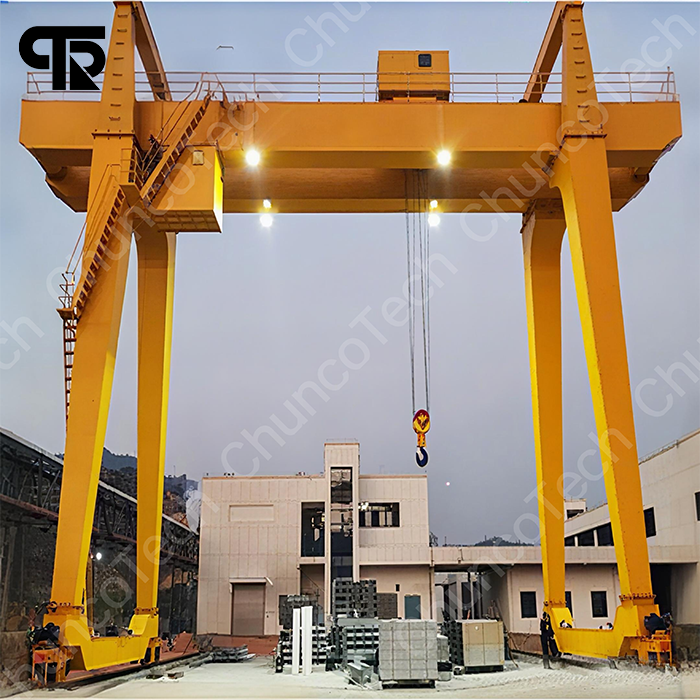
Pre-operation and During-operation: Precision Control to Bridge the "Distance Gap"
The biggest challenge in remote operation is the information attenuation caused by "distance." JT/T 1485.2-2023 proposes extremely detailed pre-operation confirmation processes. Operators need not only to understand the working conditions and tasks but also to sequentially confirm through the remote control console whether the control handles, signal indicators, and display screens are normal, and even verify the container type and category for handling. This digital "pointer-verbal" confirmation is a prerequisite for avoiding major accidents.
During the operation phase, the standard divides modes into fully automatic operation mode and semi-automatic operation mode. In fully automatic mode, operators are not "hands-off" but serve as system supervisors. Once the system prompts for manual intervention—such as when horizontal transport vehicles are misaligned or yard scanning fails—operators must immediately take over. This is precisely the moment to test the equipment's "ease of control." Wuxi ChuncoTech's remote control console is designed in compliance with the GB/T 4205-2010 human-machine interface standard, with logically arranged control handles and buttons, and millisecond-level synchronization between control commands and system feedback. This ensures that at the moment of manual intervention, operators can precisely control gantry travel (e.g., 20% of rated speed when moving across zones) or accurately lower the spreader to within 30cm of the target container for fine adjustment.
For the most critical loading/unloading operations and container stacking in yards, the standard stipulates: during manual intervention, when the spreader descends to 30cm above the target, it must pause for observation and confirmation before proceeding. During picking and placing, operators must confirm the alignment of twist locks with corner castings via the spreader monitoring camera. Wuxi ChuncoTech's integrated high-definition spreader monitoring system features strong light suppression and low-light compensation, allowing operators to clearly see container corner castings even at night or in rainy and foggy weather, solving the problems of "unclear vision and inaccurate alignment."

Exception Handling and Post-operation: Forming a Management Closed Loop
In automated operations, the ability to handle exceptions directly reflects system maturity. The standard details procedures for abnormal condition such as wind speed alarms, sudden power outages, frozen monitoring screens, and unauthorized personnel intrusion. When an automated container gantry crane malfunctions and alarms, operators must not leave their posts; after repairs, they need to recheck the equipment status. Wuxi ChuncoTech's remote control system incorporates an intelligent diagnostic module. In case of communication interruption or command mismatch, the system automatically enters a safety protection state and displays fault codes to assist operators in quick troubleshooting, avoiding accident escalation due to misoperation.
Post-operation procedures are equally. Operators must park the trolley in its designated position, retract the spreader to the 20ft position and raise it to a safe height, and system control. More importantly, they must complete detailed operation logs covering equipment status, camera conditions, communication system status, and fault records. This data provides valuable insights for preventive maintenance and continuous optimization of automated terminals.
As the workday ends, shift handover is not just a transfer of tasks but an extension of safety responsibility. Wuxi ChuncoTech deeply understands that true automation is not unmanned operation, but the optimization of human-machine collaboration. We not only provide automated rail-mounted container gantry cranes and automated rubber-tired container gantry cranes compliant with the JT/T 1485.2-2023 standard, but also offer full-cycle services from equipment selection and remote control system deployment to operator training. Our official website, https://www.chuncotech.com/, brings together numerous insights and case studies on safe remote operation procedures for container gantry cranes. Welcome to visit and communicate, and let us propel your yard operations towards a safer and more efficient future.