
In our previous discussion, we explored how continuous ship unloaders ensure uninterrupted port operations. Today, we shift our focus from the port to the shipyard. In the high-stakes environment of shipbuilding, the precise aerial turning of a hull block weighing hundreds of tons dictates the entire yard‘s production rhythm. If your critical equipment falters—whether through unsynchronized lifting or a stuck trolley—the consequences extend beyond delays to serious safety risks.
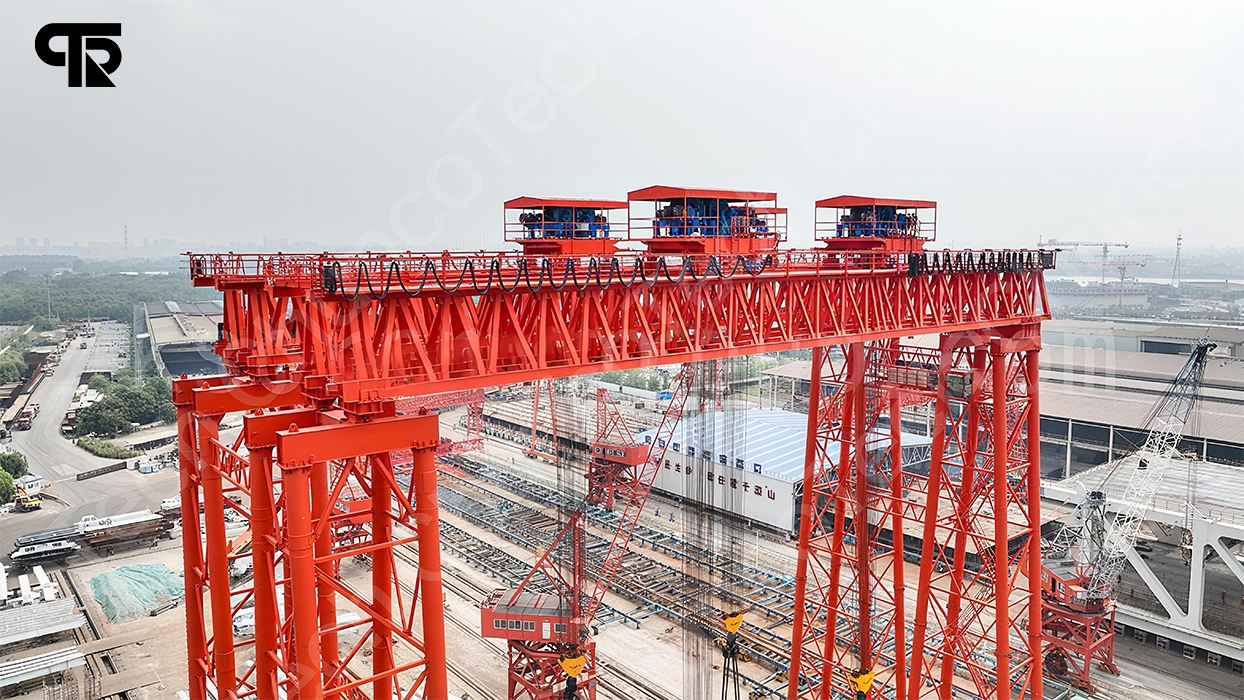
The shipbuilding gantry crane, a vital asset in docks and building berths, is defined by its heavy load capacity, vast span, towering height, and multifunctionality. According to the Chinese national standard GB/T 27997-2011 for "Shipbuilding gantry cranes," these machines utilize upper and lower trolleys to handle the complex demands of lifting and turning large ship sections. This standard applies to cranes with a rated capacity of 100t to 2,500t and a span of at least 40 meters.
Misguided Selection: The Hidden Drag on Your Shipyard‘s Productivity
Many yards select equipment based solely on maximum load, overlooking critical metrics like "turning capacity" and "load difference." The rated turning capacity is the maximum mass of a load being turned in the air by the upper and lower trolleys. If the load difference between the two hooks of the upper trolley exceeds 30% of a single hook‘s capacity, or if the lower trolley‘s rating isn't properly matched to the turning load (the standard recommends 0.55 to 0.6 times the turning capacity), operations become clumsy, unstable, and inefficient. Wuxi ChuncoTech’s shipbuilding gantry cranes are engineered from the ground up, strictly adhering to GB/T 27997-2011 to ensure perfect load matching between trolleys. This precision makes every complex turning maneuver smooth and controlled.
Synchronization Errors: The Enemy of Precision Assembly
Imagine guiding a massive hull section into place tens of meters in the air, requiring millimeter-level accuracy. This is impossible without perfect crane synchronization. The standard mandates strict control: the lift synchronization deviation between the upper trolley‘s two hooks must be under 200mm, and between the upper and lower trolleys, under 250mm. For travel, if the deviation between the rigid and flexible legs exceeds 0.3% of the span, the crane must automatically stop. This demands both sophisticated electronic control and high mechanical precision. Wuxi ChuncoTech employs proven AC drive systems, prioritizing energy feedback solutions to ensure closed-loop control for hoisting and stable operation across a wide speed range. We understand that only by strictly limiting deviation can you guarantee that every block assembly is precise and efficient.
Ignoring the Details: Turning a Priceless Asset into an Expensive Idle
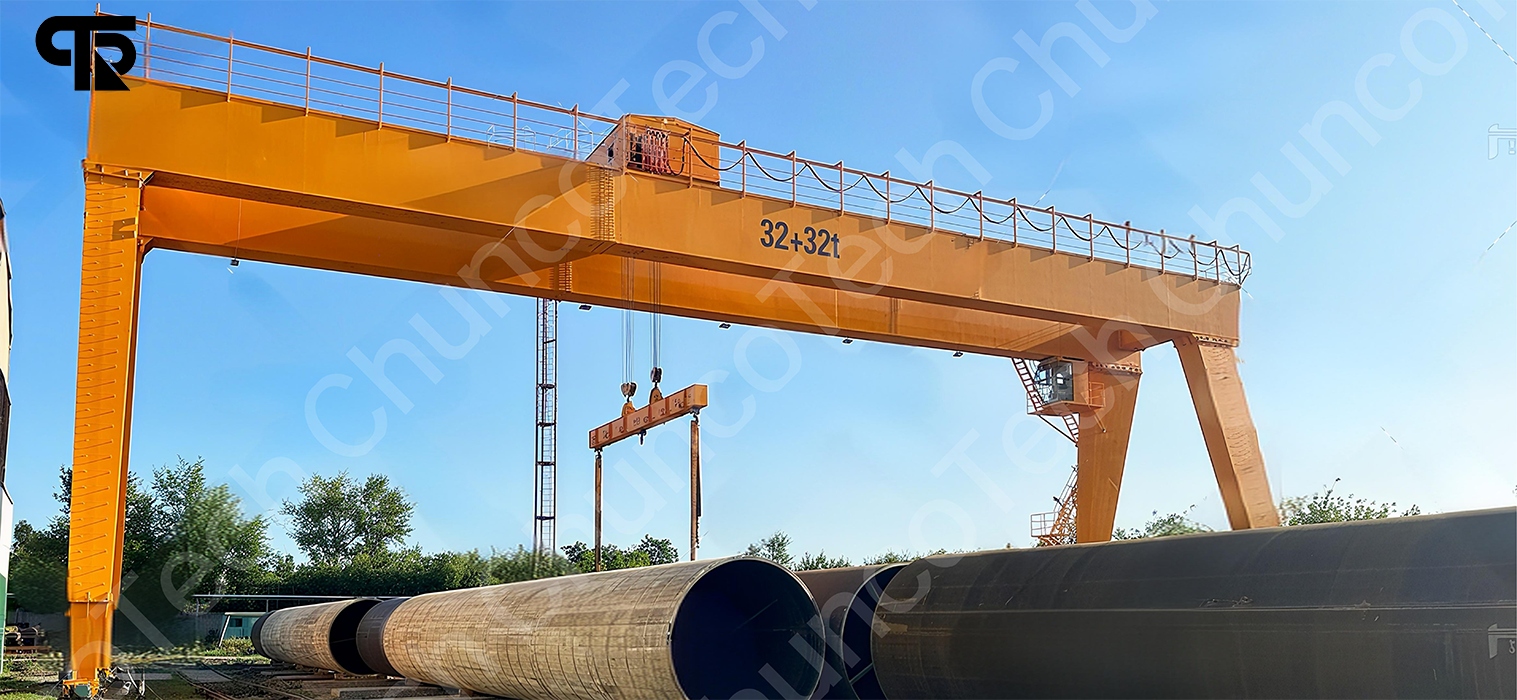
Often, overlooked details determine a machine‘s long-term reliability. Items like anti-tipping devices, skewing limiters, and automatic correction systems are non-negotiable safety features for large-span cranes, especially in harsh weather. The standard also dictates a minimum distance of 0.4m from the hook or rope to the operator‘s cab, directly impacting visibility and safety. At Wuxi ChuncoTech, we obsess over these details. We use durable steel-plate welded drums and strictly follow JGJ 82 standards for high-strength bolt connections. We ensure that height differences between rigid and flexible legs and the clearance under the gantry are held to tolerances far tighter than standard requirements. We know that a single loose bolt can be the start of a major failure .
High Maintenance Costs: The Price of "Settling" at Purchase
Many yards face crippling maintenance costs years after installation—abnormal rope wear, gearbox noise, failing electronics . This often traces back to ignoring the crane‘s duty classification. While the standard recommends a group classification of A2 to A4, the actual demands of your operation dictate the necessary component specs. Before delivery, every Wuxi ChuncoTech crane undergoes rigorous testing per GB/T 5905. We validate everything from multi-layer spooling mechanisms to overcurrent and overspeed protection. We don‘t just deliver a crane that meets GB/T 27997-2011; we deliver a mature, field-proven solution designed for minimal downtime.
Conclusion
The GB/T 27997-2011 standard is currently under revision to address trends in safety and smart control. However, the core principles remain: safety, efficiency, and precision. As a dedicated equipment supplier, Wuxi ChuncoTech doesn‘t engage in R&D, but we possess deep expertise in current standards and market applications. Our mission is to provide you with a mature, battle-tested product that forms the solid foundation for your shipyard‘s productivity. If you are planning a new dock or upgrading existing facilities, visit us at https://www.chuncotech.com/ to discuss your needs.